*Sector: Indoor Family Entertainment Center (FEC) & Location-Based Entertainment (LBE)
The global indoor playground industry is undergoing a profound structural transformation. The traditional “Soft Play” model, centered around ball pits and padded obstacles for children aged 0-8, is succumbing to severe commoditization and price wars. The evolution is clear: a shift toward Family Entertainment Centers (FEC) and Location-Based Entertainment (LBE) , which demand a completely reimagined approach to design, technology, and business modeling. For companies like Guangdong Dream Catch Recreation Equipment Co., Ltd., mastering these trends is not just about keeping pace—it is about constructing a professional moat that dramatically increases proposal acceptance rates. This report dissects five core trends driving this global shift and provides a detailed design analysis of a leading benchmark in the space: Adventure Zone by Adventure HQ in Dubai.
Trend 1: De-Infantilization and the Rise of the “Kidult” Economy
The legacy paradigm of “children play while adults supervise (and scroll on their phones)” is obsolete. The modern FEC targets a broad demographic spectrum, embracing the Kidult (Kid + Adult) economy and “co-play” experiences.
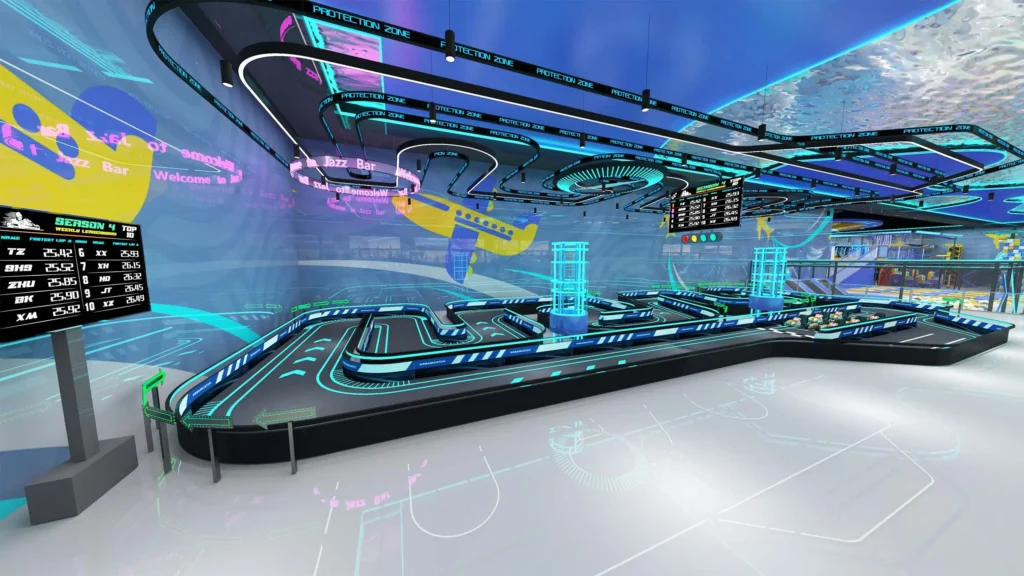
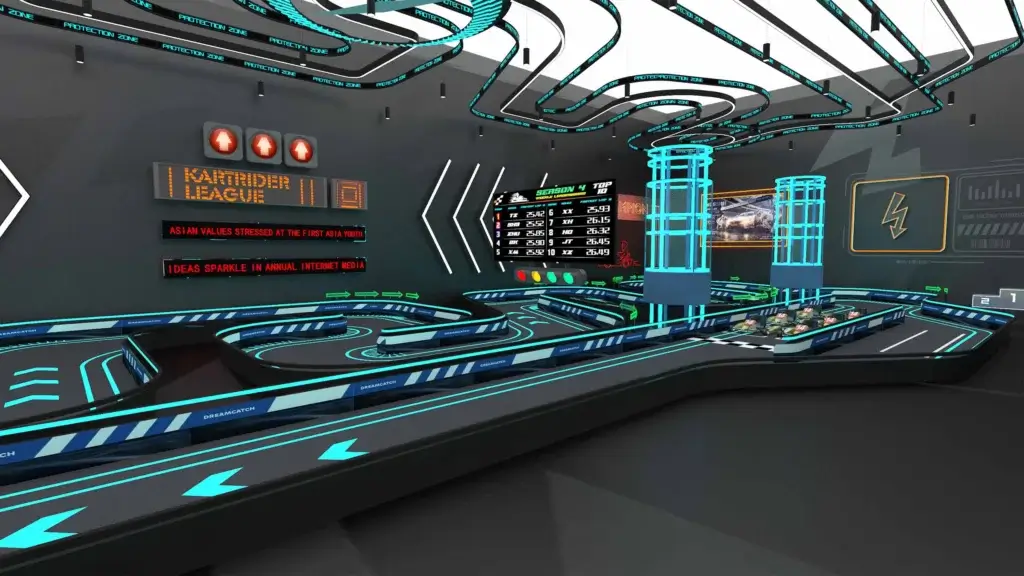
Attractions for Tweens, Teens, and Adults: Venues now integrate high-adrenaline activities such as indoor zip lines, large-format trampoline parkour, extreme rock climbing, indoor go-karts, and surf simulators. These are designed to engage the 8-18+ age bracket.
Social and Corporate Team-Building: The playground has been redefined as a social hub for young adults’ weekend gatherings and corporate team-building exercises.
Design Imperative: Circulation pathways must accommodate adult anthropometrics—ceiling heights, corridor widths, and load-bearing capacities must meet adult safety standards. Equipment engineering can no longer rely solely on pediatric specifications.
Trend 2: The “Phygital” Convergence and Gamification
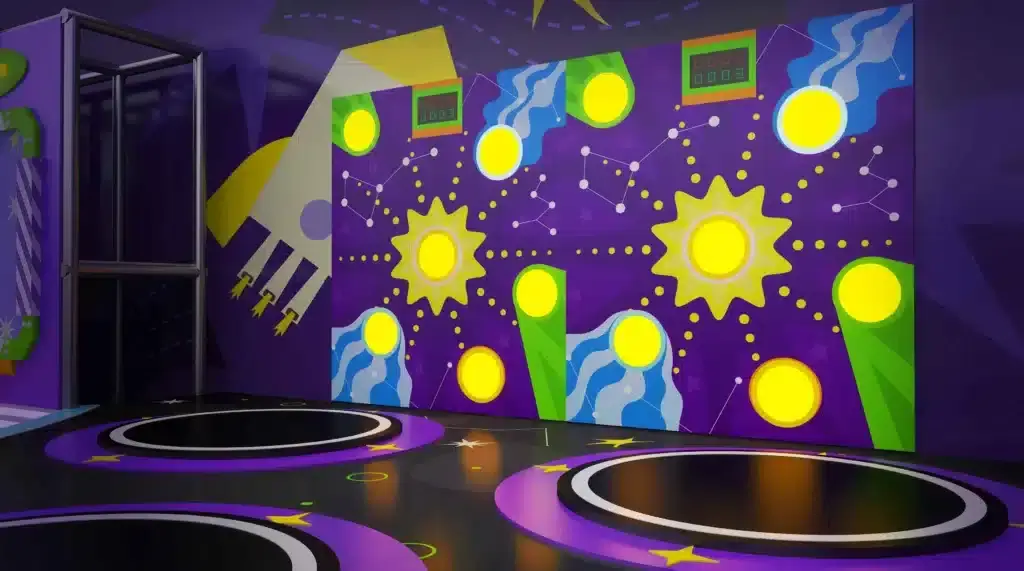
Pure physical exertion is no longer sufficient for digitally native Generation Alpha. The modern FEC experience is defined by Phygital design—the deep integration of physical and digital play.
Gamified Equipment: Interactive projection mapping transforms standard activities. Trampolines become monster-stomping missions; climbing walls feature illuminated touchpoints for level-based challenges.
RFID Wristbands and Integrated Scoring Systems: Upon entry, guests receive smart RFID wristbands to check in, time their runs, and accumulate points across multiple zones. Centralized live leaderboards turn unstructured play into competitive arenas, significantly boosting repeat visitation as guests return to defend or beat scores.
Design Imperative: Equipment R&D must move beyond pure steel and soft-padding. Modern designs require pre-integrated interfaces for lighting, audio, and sensor arrays, creating a platform for digital content updates.
Trend 3: The Aesthetic Upgrade – From Primary Colors to Instagrammability
The decision-makers—Millennial and Gen Z parents—demand spaces that reflect their own design sensibilities. The high-saturation red-yellow-blue palette has been displaced by the pursuit of “Instagrammable” environments.
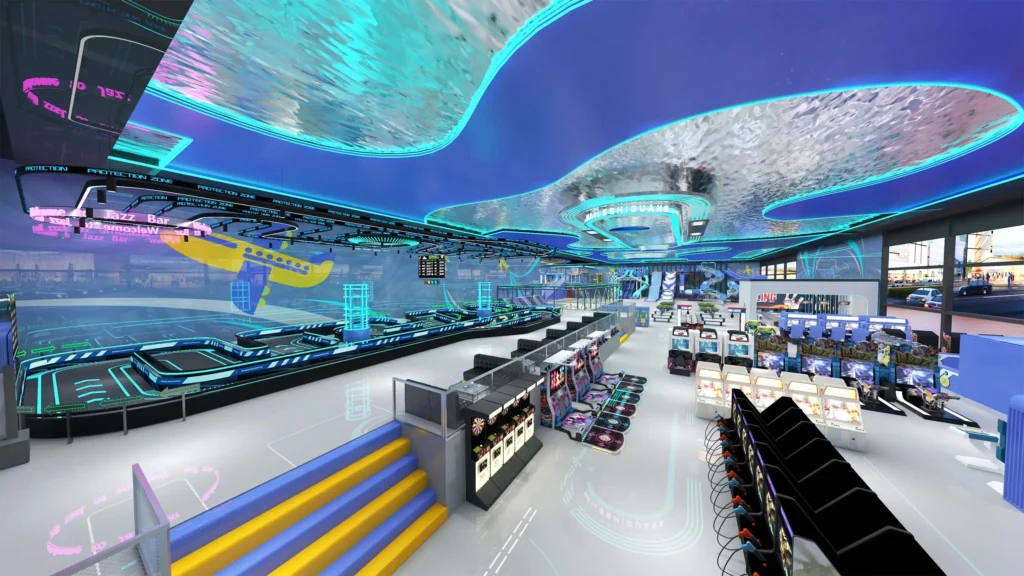
Thematic Immersion: Designers now draw inspiration from cyberpunk, industrial wasteland, space-age futurism, and minimalist biophilic (woodland) concepts.
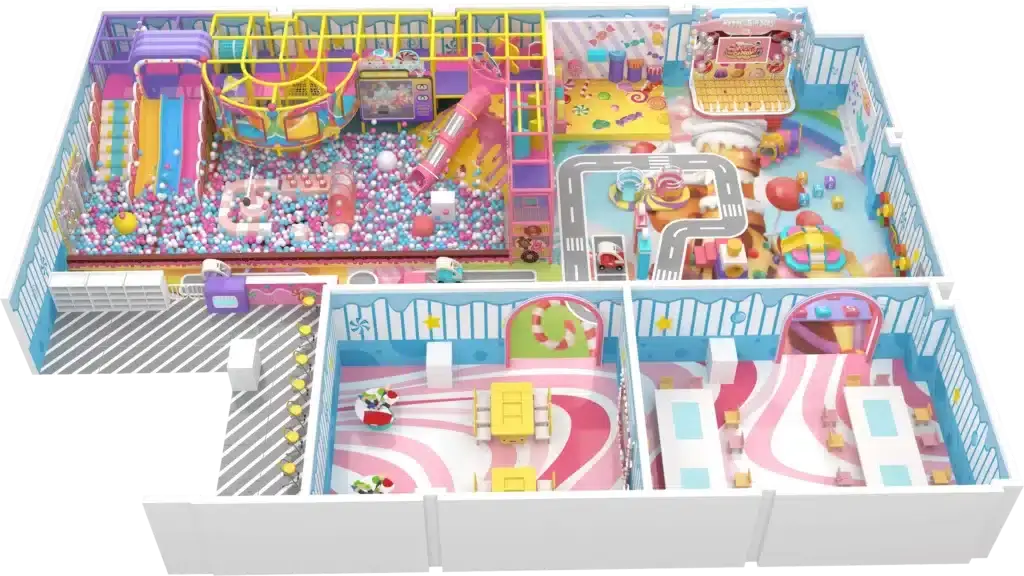
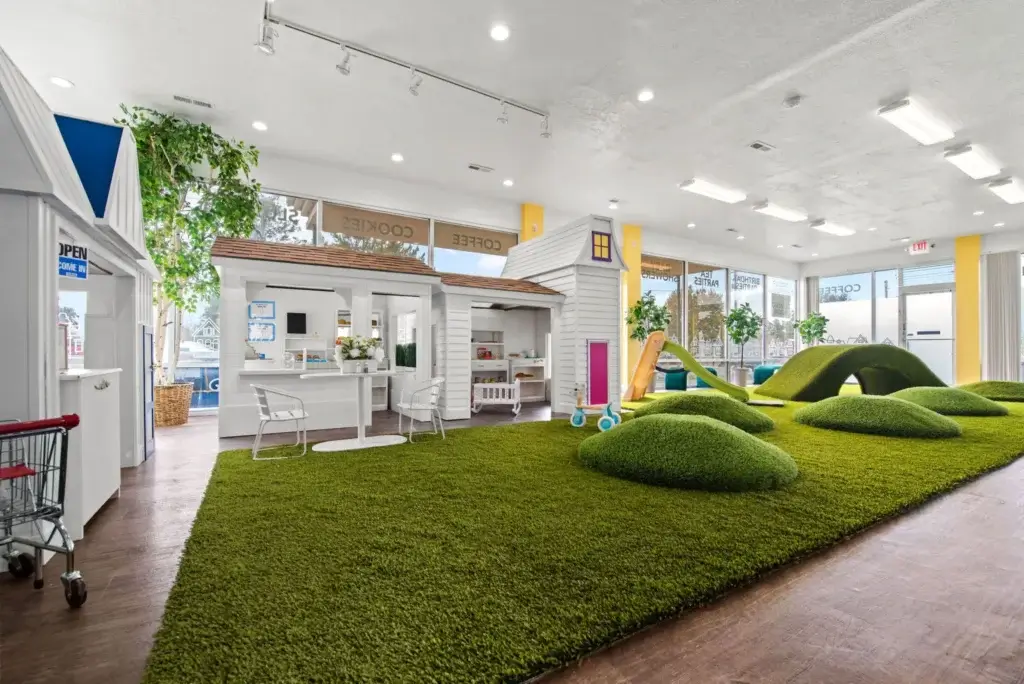
Refined Color Palettes: Even in toddler zones, designers are shifting toward sophisticated Morandi and macaron color systems (dusty pink, mint green, cream white) to achieve a high-end, serene spatial quality.
Revolutionized Lighting: The approach has shifted from blanket illumination to atmospheric accent lighting. The use of neon tubing and programmable LED strips to silhouette equipment transforms venues into nightclub-chic or futuristic experiential hubs.
Trend 4: Business Diversification and “Eatertainment”
Pure ticketing revenue models yield thin margins. The most profitable FECs, particularly in North America and the Middle East, have pivoted to Eatertainment (Eat + Entertainment).
High-Caliber F&B Integration: Offerings extend beyond popcorn and hot dogs to full-service bistros, specialty café bars, and even craft beer on tap for accompanying adults.
Extending Dwell Time: The combination of dining, retail, and immersive play extends average guest dwell time from 1.5 hours to 3-4 hours or even a half-day, multiplying per-capita spending accordingly.
Party Rooms as Core Profit Centers: In Western and Middle Eastern markets, weekend birthday parties are critical revenue drivers. Spatially, the design must prioritize highly photogenic, acoustically isolated VIP party suites that can be flexibly opened or partitioned.
Trend 5: Modular Design and Operational Cost Reduction
Operators face the critical challenge of novelty decay—guests perceive a venue as “stale” within six to twelve months of opening.
Modular Equipment Design: Advanced design allows for the rapid replacement of play components—swapping a soft-play obstacle for an interactive net maze—without altering the primary steel superstructure, achieving low-cost venue refreshment akin to Lego construction.
Automated and Passive Supervision: Adopting continuous passive safety systems (as seen in the Adventure Zone case study) reduces reliance on hourly floor staff, directly combating rising global labor costs.
Case Study: Deconstructing Adventure Zone by Adventure HQ, Dubai
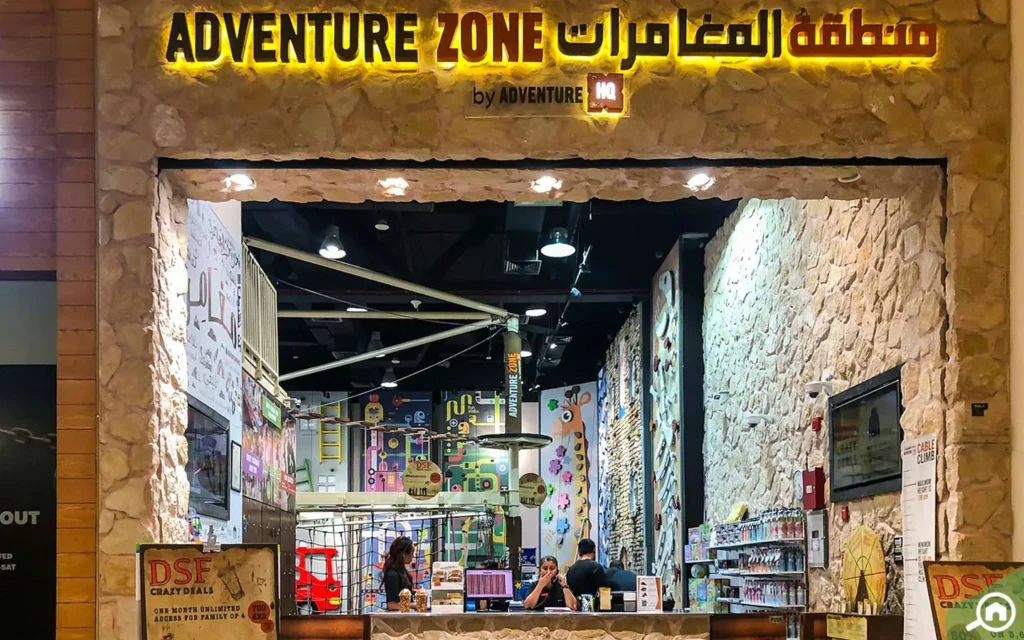
Adventure Zone, the experiential brand of the large-format outdoor retailer Adventure HQ, is a textbook example of the FEC/LBE transformation. Typically anchored in high-end malls like Times Square Center and The Galleria Mall, its target demographic shifts decisively from 0-8 to a core audience of 4-16-year-olds, supplemented by adult team-building groups. The foundational logic is Retail-tainment: hardcore indoor sports experiences drive traffic to the adjoining retail shop.
1. Space & Layout Design: Three-Dimensional Space Maximization
Dubai malls often provide generous clear heights (6-10 meters). Adventure Zone masterfully exploits this with a three-dimensional spatial plan:
High-Altitude Layer: High ropes courses and zip lines are suspended directly from the ceiling truss, consuming zero ground-level footprint.
Vertical Wall Layer: Perimeter and partition walls are lined with “Fun Walls” (thematic climbing surfaces) and bouldering walls of varying difficulty, turning dead boundary areas into active attraction surfaces.
Ground Level: This hosts footprint-heavy attractions like trampoline parks, pump tracks, or junior zones.
Negative/Interstitial Spaces: Irregular dead zones beneath staircases and behind equipment structures are converted into an intricate indoor caving system.
Takeaway: The vertical stacking strategy multiplies revenue-generating capacity within the same flat lease area.
2. Circulation & Visibility: Open-Plan Transparency and Retail Flow
Unobstructed Sightlines: The design almost entirely eliminates solid partitions. Parents in the café lounge retain full, uninterrupted visibility of children navigating the high-altitude elements. This transparency reinforces parental confidence and creates a powerful “window effect,” attracting foot traffic from the mall corridor.
Forced Retail Path: The entry or exit sequence is deliberately merged with Adventure HQ’s retail floor, ensuring that every guest traverses the sports equipment display—a masterclass in traffic monetization.
3. Core Equipment & Experience Design: “Hardcore but Safe”
The equipment selection abandons all “kiddy” aesthetics in favor of athletic, high-perceived-value challenges.
Themed Fun Walls (Gamified Climbing): Rather than austere athletic walls, these use high-saturation, molded FRP/wooden theming—such as skyscraper facades or dinosaur fossils. Crucially, integrated timers and slap-button activators inject a Gamification layer, transforming climbing into a replayable competitive sport.
Indoor Caving System: A key differentiator. Modular fiberglass tunnels simulate realistic textures (stalactites, fossils), utilizing dim dynamic lighting, spatial audio, and wind effects to create a visceral sense of subterranean exploration. The modular design allows custom snaking configurations around columns and through vertical gaps.
Cable Climb (High Ropes Course): This attraction employs a Continuous Belay System, a passive safety mechanism where guests lock in at the start and cannot detach until the exit. This design directly minimizes the operational dependency on floor-walking safety marshals, significantly lowering recurring staff costs.
4. Visual Style & Materiality: Industrial Meets Outdoorsy
Aesthetic DNA: The design celebrates structural honesty with exposed black metal trusses, wire mesh, and raw plywood. The core palette—matte black, cement grey, energetic orange, and fluorescent yellow—radiates explosive athletic energy without infantilizing the space.
Lighting Drama: Uniform floodlighting is rejected in favor of theatrical, zoned illumination. Spotlights dramatize climbing wall summits; dynamic color-changing LEDs pulse in the trampoline zone; and UV-reactive fluorescent paints create an immersive “dark light” experience in the caving tunnels.
Strategic Design Recommendations for Clients
Translating these insights, Guangdong Dream Catch Recreation Equipment Co., Ltd. advocates the following for operator clients to construct a future-proof, high-margin venue:
De-Infantilize to Elevate Per Capita Spend: Advise clients to reduce the proportion of ball pits and static soft obstacles. Integrate harness-dependent competitive attractions (climbing with Auto-belay systems, Ninja courses, high ropes). This shifts the target age ceiling from 8 to 18+ (and adults), a demographic cohort with higher willingness-to-pay and stronger repeat visitation habits.
Integrate “Invisible Safety” to Slash Operational Costs: In equipment planning, strongly recommend Auto-belay devices on climbing walls and Continuous Belay tracks on elevated courses. While initial capital expenditure is higher, these passive systems can reduce dedicated safety staff headcount by over 50%, yielding significant long-term operational savings.
Embed Gamification for Customer Stickiness: Pure physical exertion without feedback creates rapid fatigue. Embed RFID check-point challenges, interactive trampoline projection, and climbing timers. These not only elevate experiential quality but also deliver critical user data, enabling venue operators to run weekly leaderboard tournaments and membership rankings that drive loyalty.
Design for Social Monetization (Party Rooms & Eatertainment): The highest margins at Adventure Zone come from birthday parties and corporate events. Floorplans must allocate flexible, high-design party suites that maintain strong visual connectivity to the play areas while offering acoustic privacy. Couple this with an F&B offering that goes beyond snacks.
Conclusion
The evolution from Soft Play to FEC and LBE represents a fundamental re-engineering of the indoor playground’s value proposition. By embracing Kidult design, Phygital integration, Instagrammable aesthetics, Eatertainment, and Modular cost-efficiency, operators can escape the commodity trap. As demonstrated by Adventure Zone by Adventure HQ, the future belongs to venues that treat space as a three-dimensional, digitally-enhanced, and operationally intelligent asset. For a design-and-manufacture firm like Dream Catch, embedding these trends into every proposal transforms our work from equipment supply into a high-value strategic partnership.