
When you set out to build an indoor playground, one of the very first questions you will confront is: How many square meters do I actually need? The answer will define your safety standards, guest experience, and, ultimately, your return on investment. A space that is too small can lead to crowding, limited attractions, and constant risk of injury. On the other hand, a building that is far too large will drain your capital through rent, climate control, and staffing—without any guarantee of additional revenue. This guide will walk you through every dimension of the decision, from the physical footprint of specific equipment to the often-overlooked regulatory and financial constraints that must shape your final choice.
Why Size Is the Foundation of Your Business
The number of square meters you lease or build out is not just a technical detail—it is the single most consequential financial and operational decision you will make.
Safety is non-negotiable. Crowding is not merely unpleasant; it creates a hazardous environment where collisions, falls, and lost children become statistically more likely. Every single piece of play equipment, from a toddler slide to a trampoline bed, requires a clearly defined safety fall zone. These clearances are mandated by international standards such as ASTM F1918 and EN 1176. A failure to provide them endangers children and exposes your business to legal liability.
Play experience dictates dwell time and repeat visits. Children need room to explore, run, and engage in unscripted play. In a cramped environment, they become bored or overstimulated quickly. A well-proportioned space, by contrast, encourages longer play sessions, higher satisfaction, and a far greater likelihood that the family will return and recommend you to others.
Operational efficiency hangs in the balance. A playground too small to accommodate a dedicated birthday party room, or to separate toddlers from boisterous eight-year-olds, leaves significant revenue streams unrealized. Conversely, a space far larger than your market can support will generate fixed costs—rent, heating, cooling, lighting, cleaning—that eat into your margins every single month, regardless of attendance.
Customer comfort extends to adults. Your paying customers are parents and caregivers. They need seating with a clear sightline to their children, adequate restroom facilities, and, ideally, a café offering that makes them want to stay longer. Squeeze these out, and you shorten the average visit length and cut off high-margin secondary spend.
Long-term flexibility matters. A space that is exactly the size of your initial soft-play package may prove a straitjacket if you later wish to add a ninja course, a climbing wall, or more elaborate party rooms. Conversely, a modular, future-proofed layout within a suitably sized shell can keep your offering fresh for a decade.
The Factors That Determine Your Square Meter Requirements
Before you look at any floorplan, you need to assess the forces that will dictate how much space is right for your specific project. These go far beyond the equipment catalogue.
Target Age Groups
Toddlers (1–3 years) require compact, fully enclosed soft-play zones with low-level sensory equipment and soft flooring. These areas do not demand vast square meters but must be strictly segregated from older children.
Preschool and early primary (4–7 years) need climbing nets, tunnels, slides, and interactive games. They need more running room and complexity.
Older children (8–12 years) are drawn to physically challenging attractions: ninja obstacle courses, trampolines, bouldering walls, and ropes courses. All of these require substantial clear areas and higher ceiling clearances.
If you intend to serve all three age groups under one roof, your total floor area must be the sum of distinct, safely separated zones—not a single blended space.
Types of Attractions and Their Spatial Demands
Every attraction carries a minimum footprint, but also a required safety envelope. The table below provides industry-validated benchmarks for both floor area and, crucially, clear ceiling height, which many early-stage investors overlook.
| Attraction Type | Typical Floor Area Required | Minimum Clear Height |
|---|---|---|
| Soft Play Area (toddler/junior) | 100 – 400 sqm | 3.0 – 4.5 m |
| Climbing Walls (bouldering/auto-belay) | 50 – 200 sqm | 4.5 – 6.0 m |
| Ninja Obstacle Course | 200 – 800 sqm | 4.5 – 5.5 m |
| Trampoline Park (multi-court) | 500 – 1,500 sqm | 5.5 – 8.0 m (minimum) |
| Multi-Activity Family Entertainment Center (FEC) | 1,000 – 3,000+ sqm | Mixed: 4.5 – 8.0 m depending on zones |
The Crucial Dimension Often Missed: Ceiling Height
When evaluating a property, you are not just buying square meters of floor; you are renting cubic meters of volume. A 500-square-meter shell with a 3-meter ceiling can only ever be a soft-play venue. The same floor area with a 7-meter clear height can accommodate trampolines, high ropes, and multi-level climbing structures that generate far higher per-square-meter revenue. Always check for obstructions—beams, HVAC ducts, sprinkler pipes—that reduce the usable clearance, and confirm the height with a laser measure, not an estate agent’s listing.
Supporting Facilities: The “Non-Play” Space That Makes You Money
Many early calculations fail because they only account for the equipment footprint. In reality, the following support spaces can consume 25–40% of your total floor area and are essential to profitability:
Entrance, ticketing, and waiting area
Shoe-changing and locker zones
Dedicated birthday party rooms (a primary revenue driver)
Café or snack bar with seating for adults
Accessible restrooms and baby-changing facilities
Staff office, cleaning supply storage, and maintenance workshop
Circulation aisles and emergency egress corridors
If you have identified a potential site, deduct these support square meters first. The remaining clear area is what you actually have available for play equipment.
Business Model, Location Economics, and Revenue-per-Square-Meter
Your choice of size cannot be separated from your local market reality. In a high-rent, prime retail location within a shopping mall, a compact, highly designed soft-play and party center of 200–400 square meters can generate excellent returns because you are paying for convenience and footfall. On a suburban or edge-of-town site with lower rent, you may justify 1,500–3,000 square meters to create a destination that families travel to specifically.
This is where the concept of revenue per square meter (RPSM) becomes your compass. Project your realistic annual gross revenue and divide it by the total square meters you are considering. If your RPSM is not high enough to comfortably cover rent, staffing, and a loan repayment, the space is too large for your market—no matter how beautiful the design. A smaller, busier, well-run facility will almost always outperform a cavernous but half-empty one.
Navigating Regulations: Occupancy, Fire Safety, and Egress
Before you sign a lease, you must understand the local building and fire codes. These will impose hard limits on how you can use your space.
Maximum Occupancy: Your local fire marshal will determine the maximum number of people legally permitted in your venue at any one time. This figure is calculated not from your desires, but from floor area, number and width of exits, and egress path capacities. A space that seems large enough for 200 guests may be legally capped at 120, fundamentally altering your revenue model.
Emergency Exits: Every square meter you add increases the distance a person must travel to reach a safe exit. Large open-plan play areas may require additional fire doors, illuminated exit signage, and panic hardware, adding to your build-out cost.
HVAC and Smoke Management: Indoor play structures, particularly those with enclosed tubes and high platforms, can disrupt air circulation and smoke detection. A large-volume building will require a properly engineered ventilation and smoke extraction system, which must be factored into both the construction budget and ongoing utility bills.
Engage a local architect or fire safety engineer before finalizing any floorplan. A design that works perfectly on paper is worthless if it fails plan review.
Planning the Flow: How People Move Through Your Space
A playground’s layout must be designed for the peak Saturday morning rush, not the quiet Tuesday afternoon. Poor traffic flow creates bottlenecks, frustration, and safety hazards. When calculating your area, allocate space for:
Entry and Processing: A contained queuing area for ticket purchase or check-in, separate from the exit path.
Transition Zones: A clearly defined entry point where children remove shoes and stow belongings. This area must be large enough to prevent families bunching up.
Play Zone Perimeter: A circulation aisle around the main play structure allowing staff and parents to move easily without entering active play zones.
Sightlines: The café and seating should be positioned so that parents can see the main play areas without blocking circulation.
In practice, circulation and transition space can add 15–20% on top of the pure equipment footprint. Ignore it, and your otherwise perfect playground will feel chaotic and unmanageable on busy days.
Maximizing the Space You Have
Whether you are working with a tight 300-square-meter unit or a generous 2,000-square-meter warehouse, the principles of space optimization remain the same.
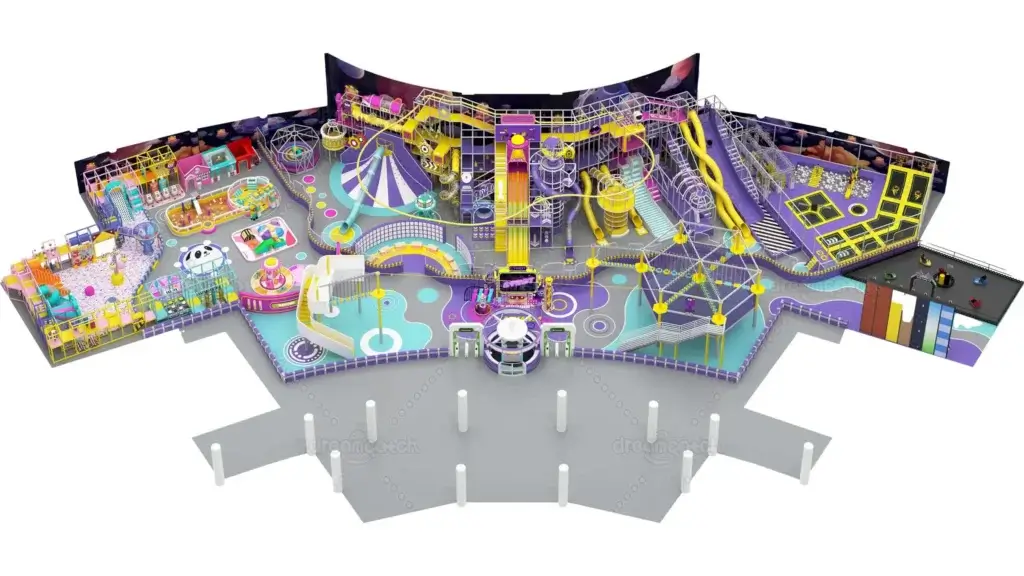
Build vertically. Multi-level play structures are the single most effective way to multiply usable play area without increasing floor area. A three-level structure occupying 80 square meters of floor can provide over 200 square meters of climbing, sliding, and exploring. Ensure that upper levels have appropriate fall containment and that the structure does not breach the clear headroom required at the highest point.
Zone by age and energy level. Place the calm, enclosed toddler zone in a low-traffic corner with its own seating. Locate high-energy activities—trampolines, ninja courses—furthest from the quiet areas and café. Use transparent fencing or low walls to maintain sightlines while providing separation.
Combine functions. A slide can discharge directly into a ball pit. A climbing net can be suspended above a foam pit. An interactive floor projection system requires no dedicated footprint at all and can turn a simple corridor into a revenue-generating attraction.
Keep the center clear. Place seating, lockers, and vending machines against the walls. The middle of the space should be reserved for active play and movement. This approach makes a modest footprint feel significantly larger.
Design for future change. Install modular equipment that can be reconfigured or expanded. Leave one wall or corner initially furnished as a simple seating area or storage, but with the necessary utilities and sightlines to be converted into a ninja course or third party room when your revenue supports it.
Bringing It Together: A Decision Framework
To determine how many square meters your indoor playground truly needs, work through these steps in order:
Define your core offerings. List the specific attractions you want at launch, and those you may add in years 2–3.
Calculate the equipment footprint plus safety zones. Use the ranges provided in Section 2.2, and request precise CAD data from potential equipment suppliers.
Add support spaces. Include party rooms, café, restrooms, reception, lockers, and storage. This often adds 30–40% to the pure play area.
Check the regulatory ceiling. Verify the maximum occupancy, egress requirements, and ceiling height constraints with your local authority for any prospective site.
Run the revenue-per-square-meter model. Project your realistic annual revenue based on conservative attendance estimates and local ticket prices. Divide that figure by the total square meters. Compare this number against your projected total occupancy cost (rent, common charges, property insurance, utilities). If the math does not show a clear path to profitability, adjust the size downward, renegotiate the rent, or reconsider the location entirely.
Validate with professional plans. Once you have a rough target size, engage an experienced indoor playground designer or architect to create a concept layout. This plan should demonstrate that safety clearances, circulation, sightlines, and fire egress all work in concert.
Conclusion: Size Smart, Not Just Big
Choosing the right number of square meters for your indoor playground is an exercise in disciplined planning, not wishful thinking. Safety, child development, guest comfort, and long-term business viability all flow from this single, early decision. The most successful playgrounds are not necessarily the largest; they are the ones where every square meter has been scrutinized for its contribution to safety, revenue, and guest experience.
Precise measurement, a thorough understanding of the hidden demands of building codes and human flow, and a cold-eyed financial model are your best tools. Do not let the size of your dreams outrun the reality of your market. When you align your space with a well-researched business strategy, you create not just a playground, but a sustainable, beloved community asset that can thrive for years.