*For Commercial Developers, FEC Operators, and Mall Lessees*
Speed Without Precision Is Just a Guess
In commercial indoor playground projects, time is money—literally. Every week of delay costs rent, pushes back revenue, and risks losing the competitive edge. That is why fast design turnaround, such as 12-hour 2D layouts and 36-hour 3D visualizations, has become a game-changer for investors who need to move quickly.
But here is the critical truth: speed only delivers value when the input data is accurate. A 36-hour 3D design built on unverified assumptions is not a shortcut—it is a detour to rework, budget overruns, and approval failures.
This guide is written for decision-makers who want both speed and precision. It explains exactly what site details you must collect before requesting a design or quote for a commercial indoor playground—and how Guangdong Dream Catch’s rapid design process turns that data into an actionable, permit-ready solution.
Why Indoor Playgrounds Demand Different Site Data Than Outdoor Parks
Outdoor playgrounds deal with soil, drainage, and weather. Indoor playgrounds live inside a building—a fixed shell with its own constraints. The “ground” is a concrete slab. The “sky” is a ceiling full of sprinklers, ducts, and beams. The “boundaries” are walls, columns, and fire exits that cannot move.
Collecting the wrong data—or missing critical details—means your beautiful 3D design may be impossible to install, fail fire inspection, or operate at a fraction of its intended capacity.
Below are the essential site details that form the foundation of any reliable indoor playground design and quote.
1. Clear Height – Measured to the Lowest Obstruction
This is the single most important number for indoor playgrounds. Children’s play structures are built vertically to maximize play value per square foot. But you cannot design a three-level structure if the ceiling height is only 3.5 meters.
What to measure: Distance from finished floor to the lowest overhead obstruction—sprinkler heads, light fixtures, HVAC ducts, beams, or dropped ceilings.
Why it matters: A 30 cm error in height can eliminate an entire play level, reducing capacity by 30% or more. Our 12-hour 2D layout depends on accurate height to determine how many tiers your structure can safely accommodate.
Common mistake: Measuring to the ceiling instead of to the lowest hanging fixture. Sprinkler heads often hang 15–30 cm below the slab.
2. Floor Loading Capacity – Can Your Structure Stay Up?
Multi-level indoor playgrounds are heavy. Add children jumping, running, and gathering in groups, and the live load becomes substantial. Most shopping mall floors are designed for retail loads (around 3–5 kN/m²), but a dense soft play area may require higher ratings.
What to obtain: Structural drawings or a letter from the building owner stating the allowable uniform and point load capacities.
Why it matters: If you design a towering play structure on a floor that cannot support it, you will face costly structural reinforcements—or a denied permit. We need this number before we can commit to a safe, code-compliant layout.
Pro tip: For upper floors (second level or higher), request the load capacity in writing. Do not rely on verbal assurances.
3. Column Locations and Spacing – The Unmovable Obstacles
Columns are the permanent “walls” inside open floor plans. They cannot be relocated. Yet many design requests ignore them, resulting in layouts that collide with structural supports.
What to map: Position, dimensions, and spacing of all columns within your leased area. Also note any shear walls, elevator shafts, or stairwell enclosures.
Why it matters: A column placed in the middle of your intended ball pit forces a complete redesign. By providing column locations upfront, our 36-hour 3D design can weave the play structure around these obstacles—turning constraints into design features (e.g., wrapping a climbing net around a column).
Best practice: Obtain as-built drawings or perform a laser measurement on site.
4. Fire Safety Features – Sprinklers, Exits, and Smoke Control
Indoor playgrounds are subject to intense fire code scrutiny. The fire marshal will inspect every detail: sprinkler coverage, exit access, travel distance, and material flammability.
What to document:
Location of all sprinkler heads and their coverage area
Fire exit doors and required clear egress paths (minimum 1.2 m wide, unobstructed)
Location of smoke detectors, fire alarm pull stations, and fire extinguishers
Any fire-rated walls or smoke curtains that cannot be penetrated
Why it matters:
Play equipment cannot block sprinkler spray patterns or exit paths. If your design covers a sprinkler head, you will need to relocate it—at your cost. If it blocks an exit, the plan is rejected. Our design team flags these conflicts early, but we need the data to do so.
5. HVAC and Ventilation – Air Quality That Keeps Families Coming Back
Indoor playgrounds trap heat, humidity, and odors. Parents notice stale air immediately—and they will not return. Proper ventilation is not a luxury; it is a health and business requirement.
What to collect:
Location of supply and return air vents
Air exchange rate (how many times per hour the room air is replaced)
Capacity of the HVAC system to handle additional heat load from active children
Why it matters:
If your design blocks a return air grille, the room becomes stuffy. If the system is undersized, you will face complaints and potential respiratory concerns. Our layouts respect vent locations, but we rely on your site data.
6. Electrical and Data Points – Powering Interactive Play
Modern indoor playgrounds include digital interactive floors, scoring systems, ticket redemption kiosks, and security cameras. All need power and network connectivity.
What to map:
Location of existing electrical outlets and panels
Available amperage for new equipment
Network cable runs or Wi-Fi coverage areas
Preferred locations for screens, projectors, and payment terminals
Why it matters:
Adding new circuits after the playground is built is disruptive and expensive. Pre-planning electrical placement during the 12-hour design phase saves weeks of construction time.
7. Sightlines and Supervision – The Parent’s Peace of Mind
Parents will only stay—and spend money on coffee and snacks—if they can see their children easily. Columns, walls, and tall equipment can create dangerous blind spots.
What to assess:
Where will parents sit? (coffee area, benches)
Which play zones must be visible from those seats?
Are there any structural obstructions that block views?
Why it matters:
We can design openings, low-height panels, or mirrored surfaces to improve visibility. But we need to know your supervision strategy first. A design that ignores sightlines leads to anxious parents and shorter visits.
8. Access for Construction – Can Equipment Get In?
Commercial play equipment arrives on pallets, often via freight elevator or loading dock. Oversized components may not fit through standard doorways or around tight corridors.
What to verify:
Dimensions of freight elevator (height, width, depth)
Width of all doorways and hallway turns from delivery point to your space
Stairwell clearance if elevator is unavailable
Window or exterior access options for crane or boom lift (for ground-floor units)
Why it matters:
We have seen projects where the equipment was built, shipped, and then could not enter the building. The result: disassembly, repackaging, and thousands in extra labor. By collecting access data upfront, we design for installability.
How Guangdong Dream Catch Turns Your Site Data into a Competitive Advantage
Now that you understand what to collect, let us talk about what we do with it.
At Guangdong Dream Catch Recreation Equipment Co., Ltd., we have engineered a design process that balances speed with accuracy. Our promise:
12-Hour 2D Layout – From verified site measurements, we produce a dimensionally accurate floor plan showing play zones, equipment placement, use zones, and circulation paths. This layout is ready for initial budget approval and space planning.
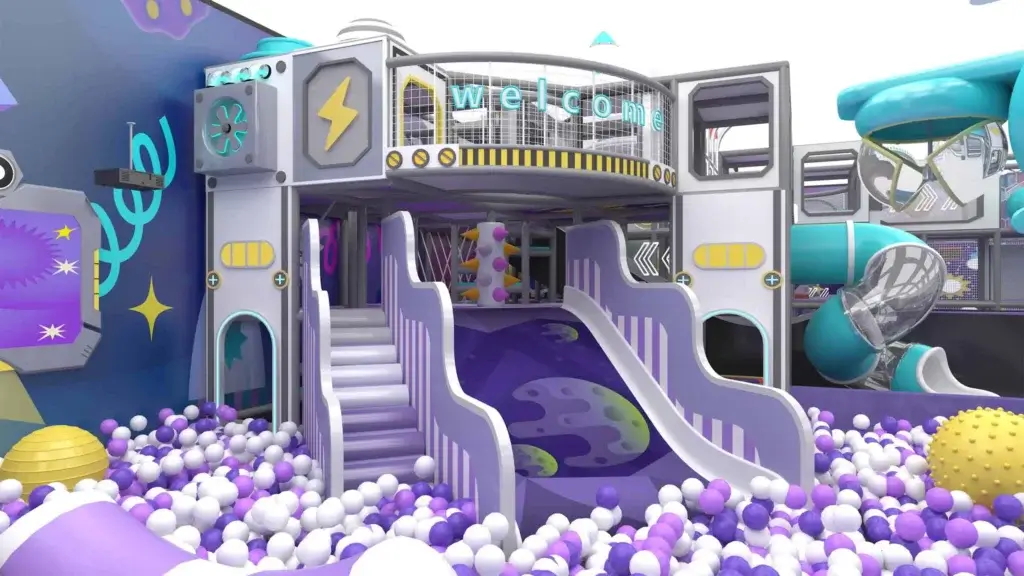
36-Hour 3D Design – Once the 2D layout is approved, we create a full-color, photorealistic 3D model of your indoor playground. You see exactly how the structure will look, how children will move through it, and how it integrates with columns, sprinklers, and seating areas.
But this speed requires disciplined inputs. Our team cannot design around constraints you have not shared. That is why we provide every client with a Site Data Checklist before we begin. When you fill it completely, our 12/36 clock starts—and you receive a design that is not only fast but also buildable, permit-ready, and profitable.
What Happens When Site Data Is Incomplete?
To underscore why this matters, consider the alternative:
You provide rough dimensions and a few photos. We design a spectacular 3D playground in 36 hours.
You present it to the landlord or fire marshal. They ask: “Where is the sprinkler head? What is the floor load?”
You cannot answer. The design is rejected. You go back to us for a redesign. That adds weeks and additional fees.
Worse, you proceed without approval, install the playground, and fail final inspection. Then you face fines, removal costs, and lost revenue.
All of this is avoidable. Five extra hours spent measuring and documenting site conditions before requesting a design saves months of delays later.
Your Pre-Design Checklist – Printable Summary
Use this list before contacting any playground supplier. Check off each item:
Clear height (to lowest obstruction) – measured in meters/feet
Floor loading capacity (kN/m² or psf) – written documentation
Column locations and dimensions – as-built drawing or sketch
Fire sprinkler head positions and exit locations – marked on plan
HVAC supply/return grilles – locations noted
Electrical outlets and panel capacity – amperage and positions
Freight elevator and doorway dimensions – width, height, depth
Parent seating area and sightline requirements – preferred supervision zones
When you provide these, Guangdong Dream Catch can deliver a 12-hour 2D layout and 36-hour 3D design that will hold up under review, fit your space perfectly, and open on schedule.
Speed Just a Tool, Not a Magic
Fast design is a powerful advantage in commercial indoor playground development. It accelerates decision-making, secures leases, and impresses investors. But speed without accurate site data is just guesswork—and guesswork fails inspections.
At Guangdong Dream Catch, we are committed to being your partner in rapid, reliable playground delivery. Our 12/2D and 36/3D design services are built on a foundation of precision. Give us the right inputs, and we will give you a design that is fast, safe, and built for success.
Ready to start? Download our Site Data Checklist or contact our design team today. Let us turn your space—measured correctly, once—into a playground that families will love for years.