In the highly fragmented indoor playground industry, the transition from independent operator to competitive market player is fraught with risk — poor site selection, mismatched equipment, and safety blind spots can cripple a venue within its first year. Luv 2 Play has positioned itself not merely as a franchise brand, but as a comprehensive de-risking ecosystem for entrepreneurs. By adopting a “no request too ambitious” philosophy and curating a global network of innovative manufacturers and experience designers, the company has transformed the complex, multi-disciplinary challenge of building a Family Entertainment Center (FEC) into a standardized, turnkey product. This analysis deconstructs Luv 2 Play’s franchise model through the professional lenses of commercial space design, amusement equipment planning, and circulation layout, revealing the institutional knowledge embedded in its system that allows first-time business owners to operate with the sophistication of corporate chains.
1. Commercial Space Design: Parent-Centric Comfort and Calibrated Brand Standardization
Luv 2 Play’s promise of “full-service venue design” and its ambition to set the global standard for premium indoor play experiences translate into a spatial design philosophy that prioritizes the paying customer — the parent — while maintaining the replicability demanded by a franchise system.
1.1 The Parent-Centric Spatial Inversion
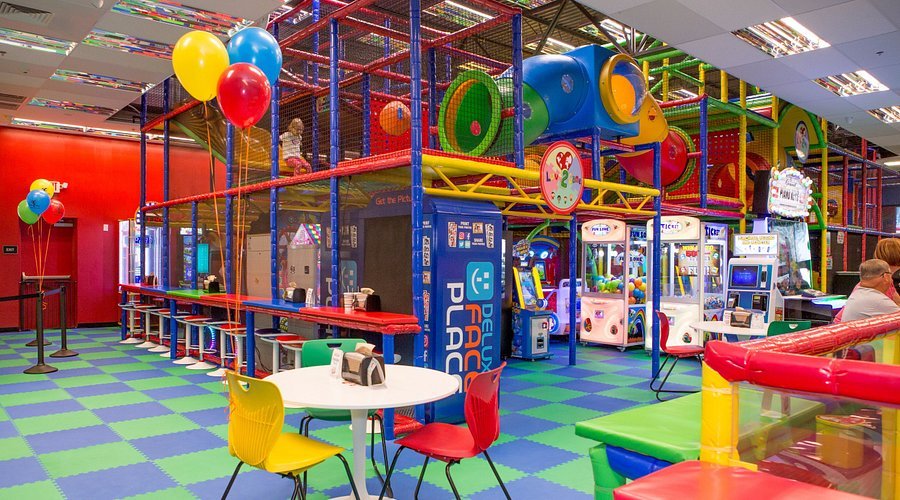
Unlike legacy playgrounds that design exclusively for the child’s perspective, Luv 2 Play deploys a parent-centric design strategy. The business logic is simple: parents control the visit duration and the wallet, and their comfort directly dictates dwell time. Spatial planning therefore integrates expansive, high-visibility parental rest areas that function as hybrid café-lounges. With ergonomic seating, high-speed Wi-Fi, abundant charging stations, and clear sightlines to all play zones, the design reframes the forced “play supervision” experience into a productive “co-working” or relaxation period for adults. This deliberate inversion materially extends the average family dwell time, the single most critical multiplier of per-capita spend in a pay-to-play or hourly admission model.
1.2 Standardization Meets Customization: The Modular DNA
As a franchise system, Luv 2 Play must balance a consistent brand identity against the unavoidable variability of commercial real estate. The “no request too ambitious” mandate demands a modular yet adaptable architectural kit-of-parts. The venue deploys a unified Visual Identity System (VIS) — a specific palette of high-saturation yet non-abrasive colors, bright and transparent lighting schemes — but the physical components are prefabricated and parametrically configurable. Based on the output of the company’s site selection analytics (assessing ceiling heights, column grids, and load-bearing capacities), the three-dimensional play structure can be morphed and adapted without breaking brand coherence. This approach dramatically lowers the barrier to entry by transforming a bespoke architectural project into a predictable assembly process.
1.3 Materiality and Premium Perception
To escape the stigma of cheap, disposable “kiddie warehouses,” Luv 2 Play emphasizes a premium tactile environment. The material specification aggressively avoids the “cheap plastic feel” of low-end soft play. Instead, it employs high-grade fire-retardant soft padding, antimicrobial surfaces, and a color psychology system that is vibrant but curated to avoid sensory overstimulation. This builds an implicit, non-verbal trust signal of “professional, safe, and hygienic,” which is essential for converting first-time visitors into repeat, membership-based customers.
2. Amusement Equipment Planning: Granular Age Stratification and the Phygital Ecosystem
Luv 2 Play’s global supply chain integration allows it to curate cutting-edge attractions that do more than entertain — they compartmentalize risk and multiply ancillary revenue.
2.1 Strict, Physically Segregated Age Zoning
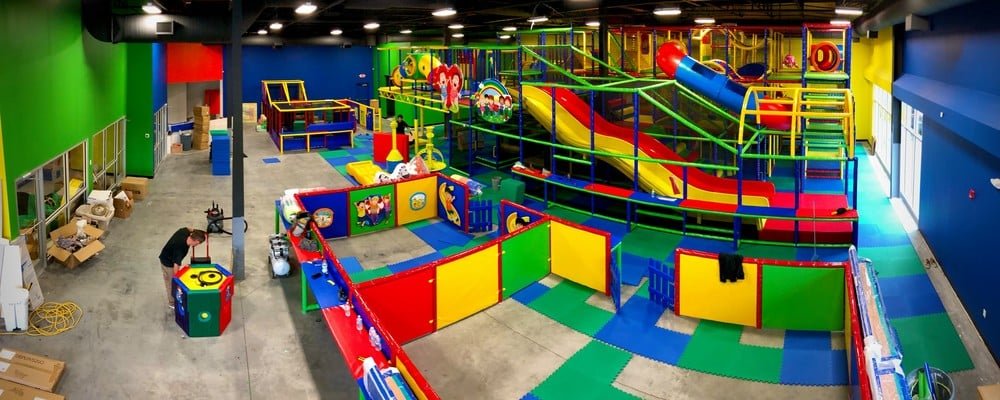
The equipment plan is engineered to eliminate the single biggest source of liability and customer complaints in indoor playgrounds: age mixing. The venue is parsed into physically isolated zones with clear developmental boundaries:
0–2 Years (Crawler Zone): An enclosed sensory haven featuring soft padding, low-stimulus tactile walls, and miniature crawling obstacles. Physical barriers prevent high-energy older children from entering.
2–5 Years (Toddler Zone): Includes scaled-down slides, interactive sand tables, and, critically, a Pretend Play / Mini Town (miniature supermarket, hospital, kitchen). This station satisfies early childhood developmental needs and is highly valued by the parent demographic.
5–12 Years (Main Play Structure): A giant multi-level soft-play labyrinth incorporating high-energy elements such as steep “devil” slides, volcano climbers, eruptive ball pits, and pneumatic ball launchers.
This rigorous zoning is not merely an amenity; it is a core component of the de-risked operational model promised to franchisees. It proactively mitigates accident risk and simplifies staff supervision.
2.2 Phygital Integration as a Modern Expectation
In line with the “cutting-edge attractions” positioning, Luv 2 Play integrates Phygital (Physical + Digital) elements directly into traditional soft-play equipment. Interactive floor projections, AR-enabled trampolines, and ball-throwing interactive walls transform repetitive physical exertion into goal-oriented, gamified challenges. This technology layer dramatically boosts the replay value of standard steel-and-foam structures, giving the venue a “tech-forward” halo that differentiates it from legacy competitors and justifies a premium admission price.
2.3 Ancillary Revenue Generators Embedded in the Plan
Beyond the main play structures, the equipment specification intentionally includes compact, high-margin ancillary revenue generators. Small arcade zones, claw machines, and candy grabbers are integrated into the circulation paths. These units occupy minimal square footage but yield extremely high margins, functioning as a critical lever to boost the venue’s overall revenue per square foot without adding labor cost.

3. Circulation and Layout: The Security Funnel, the Visual Hub, and the Revenue Pathway
Luv 2 Play’s promise of “ongoing operational coaching” presupposes a venue layout engineered for effortless operational control. The circulation design is a masterclass in passive security and intentional guest flow.
3.1 The Funnel-Style Security Entry/Exit
The highest operational risk for an indoor playground is a lost child incident. Luv 2 Play’s entry and exit flow is therefore architected as a mandatory single-point security funnel. All ingress and egress is channeled through an electronically gated vestibule, managed by a matching wristband verification system that binds each child to their guardian. This unidirectional, controlled flow enables a single staff member to manage entry/exit security with near-zero error, a textbook example of a low-labor, high-security passive design that directly reduces franchisee operating costs and catastrophic risk.
3.2 Hub-and-Spoke Visibility Layout (The Parental Sightline Loop)
The internal layout follows a strict hub-and-spoke visual architecture. The central parental lounge and café are positioned as the visual nucleus of the venue. All play zones — toddler, main structure, pretend play — radiate outward from this central hub. The planning eliminates any vertical or horizontal sightline obstructions, meaning a seated parent can visually sweep the entire venue without moving. This closed visual loop directly attacks the parental anxiety that triggers early departures; when a caregiver feels their child is always in view, the friction to ordering another coffee and extending the stay dissolves completely.
3.3 The Invisible Pathways to High-Margin Conversion
The layout is weaponized for passive revenue generation through two deliberate design moves:
Party Rooms as Live Advertising: Birthday parties are the highest-margin product in indoor play. Party rooms are given a dedicated, semi-isolated circulation zone so that private events do not interfere with general admission flow. However, their glass frontages are deliberately placed along the main arterial walkway at high exposure. This turns the celebration itself into a continuous, authentic “live advertisement” for the party-hosting service, subtly converting walk-in guests into future bookings.
F&B Forced Exposure: The café order point is positioned as a pinch point on the main circulation route, adjacent to the parental lounge. The aromas of popcorn and fresh pizza are not accidental; they are a sensory cue on the unavoidable path back to seating, driving impulse purchases seamlessly and without any hard-sell.
Conclusion: The FEC as a Franchise Product
Luv 2 Play’s strategic genius lies in its transformation of a complex design-and-operate challenge into a packaged financial product. The brand does not merely sell a soft-play structure and a brand name; it delivers an entire operational machine in which spatial design, equipment layering, and circulation are pre-engineered to minimize labor, mitigate liability, and maximize ancillary spend. By productizing institutional expertise — global vendor networks, parent-centric spatial psychology, and security-first layout principles — Luv 2 Play offers franchisees a genuinely low-risk entry into the indoor FEC market. For the industry at large, it represents a benchmark in how design can be systematically deployed to turn a chaotic play space into a predictable, scalable, and highly profitable family entertainment asset.