Choosing the right location is one of the most important decisions when opening an indoor playground in Canada.
A well-designed facility can attract families, generate birthday party bookings, encourage repeat visits, and build a strong local reputation. However, even an attractive playground with excellent equipment may struggle if it is located in the wrong neighbourhood, has inconvenient access, or carries rental costs that its customer base cannot support.
The challenge is that the best location is not necessarily the busiest shopping centre, the largest commercial unit, or the property with the lowest rent.
The best location is the one that brings together the right customers, sufficient local demand, convenient access, suitable premises, and sustainable operating costs.
For a small indoor play café serving families with toddlers, proximity to residential neighbourhoods may be especially important. For a large family entertainment centre (FEC), a wider regional catchment area, convenient parking, and access to major roads may matter more.
This guide explains how to evaluate potential indoor playground locations in Canada, analyse local demographics, assess competition, compare property types, calculate occupancy costs, and identify potential problems before signing a commercial lease.
Whether you are planning your first indoor playground or expanding an existing entertainment business, the goal is to help you make a location decision based on evidence rather than intuition.
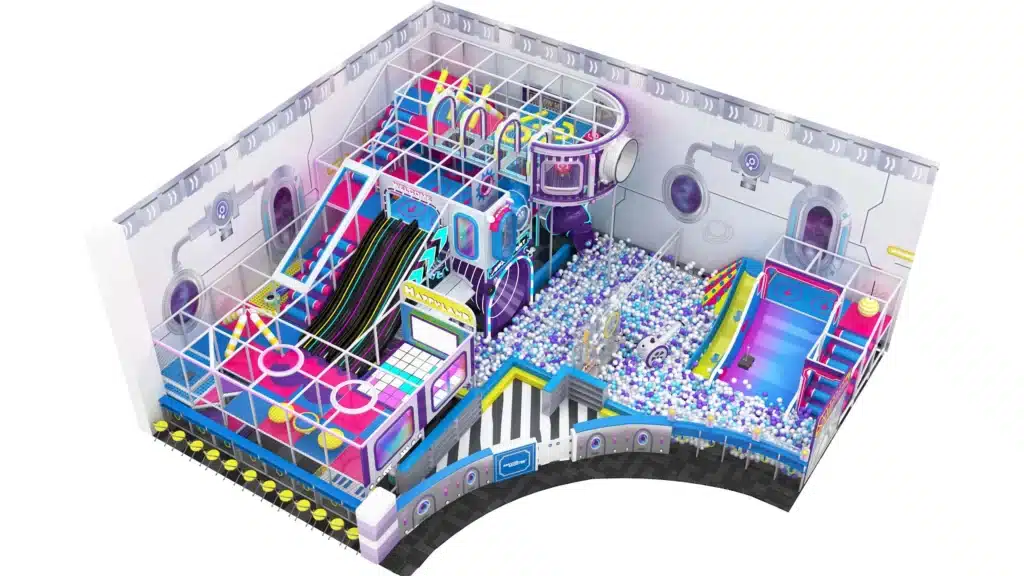
Start with Your Business Model, Not the Property
One of the most common mistakes investors make is searching for commercial space before defining the business they want to operate.
A property may look attractive, but its size, location, and rental cost may not match the intended business model.
Before viewing properties, answer three questions:
Who are your target customers?
How often do you expect them to visit?
How will the business generate revenue?
Your answers will determine which locations deserve further investigation.
Small indoor playground or play café
A small indoor playground or play café typically focuses on younger children, parents, and caregivers.
Its revenue may come from admission fees, memberships, refreshments, and small birthday parties.
Potential location priorities include:
Residential neighbourhoods with young families.
Convenient access for short visits.
Nearby childcare centres, preschools, and family-oriented businesses.
Comfortable parent seating and accessible facilities.
Reasonable rent that supports repeat-visit pricing.
For this model, convenience can be more valuable than exposure to large numbers of unrelated shoppers.
A parent who can reach the venue easily, park without difficulty, and return regularly may be more valuable than a passing customer who visits only once.
Traditional commercial indoor playground
A medium-sized indoor playground may serve children across a wider age range and generate revenue through general admission, memberships, birthday parties, school groups, and refreshments.
This model often benefits from a strong suburban catchment area, convenient road access, sufficient parking, and nearby family-oriented destinations.
The property must also support the planned equipment layout, reception area, seating, party rooms, washrooms, storage, and staff facilities.
Large family entertainment centre
A large FEC may combine playground structures with trampolines, climbing attractions, arcade games, interactive activities, party rooms, and food service.
Its customers may travel farther because the venue offers a broader entertainment experience.
Potential priorities include:
Access from multiple residential communities.
Strong regional road connections.
Adequate parking during peak periods.
A building capable of supporting the planned attractions.
Space for group bookings and birthday parties.
Sufficient local demand to support a larger investment.
A large FEC should not be evaluated using exactly the same assumptions as a small neighbourhood play café.
The larger facility may have greater revenue potential, but it also carries greater exposure to rent, payroll, maintenance, utilities, and other fixed costs.
Practical rule: Define the business model first. Then search for a location that supports it.
Understand Your Target Customers and Trade Area
A trade area is the geographic area from which a business expects to attract customers.
For an indoor playground, the trade area may be more useful than the population of the city as a whole.
A city with one million residents does not automatically offer a better opportunity than a smaller city. The important question is how many potential customers live within a reasonable journey of the proposed site, and how many of them are likely to visit and pay for the experience.
Think in travel time, not just kilometres
Two properties may be five kilometres apart but offer very different levels of accessibility.
One may be close to residential neighbourhoods and major roads. The other may be separated from nearby families by congested intersections, difficult turns, or limited parking.
Instead of relying only on a circular radius on a map, evaluate realistic travel times.
As an initial planning exercise, you might investigate:
A short local drive for a neighbourhood play café.
A broader suburban catchment for a traditional indoor playground.
A wider regional area for a destination FEC.
These are starting hypotheses, not universal travel thresholds. Actual customer travel patterns depend on the attraction mix, competition, local road network, weather, and the uniqueness of the venue.
Analyse the population within your catchment area
For each shortlisted location, investigate:
Total population.
Number of families with children.
Number of children in your target age groups.
Household income.
Household composition.
Recent population growth.
New residential developments.
Existing family recreation options.
Statistics Canada’s Census Profile provides demographic information at multiple geographic levels, including census metropolitan areas, municipalities, and smaller areas. Its annual table on census families with children by children’s age groups can also help investors compare family demographics across metropolitan areas.
Useful official resources include:
Use the most relevant available geographic level for your analysis. A citywide figure may hide important differences between neighbourhoods.
Match the demographics to your concept
Consider two hypothetical locations.
Location A: A dense urban neighbourhood with many young families, limited parking, high rent, and several existing children’s activity venues.
Location B: A growing suburban community with a younger family population, convenient parking, somewhat lower rent, and fewer direct competitors.
Location B might be a stronger choice for a family-oriented indoor playground. However, that conclusion would still need to be tested against household spending power, travel times, local demand, competition, and realistic revenue projections.
The purpose of demographic research is not to find a neighbourhood that looks attractive on paper. It is to determine whether enough potential customers can reach the venue conveniently and whether the business can serve them profitably.
Evaluate Local Demand, Not Just Population Size
A large number of families does not automatically translate into enough paying customers.
Some families may prefer free public facilities. Others may have limited discretionary spending, already belong to competing venues, or live too far away to visit regularly.
A useful location analysis therefore goes beyond counting children.
Identify the needs of local families
Ask what families in the area may be looking for:
A convenient place to play during winter or bad weather.
A safe, age-appropriate environment for toddlers.
Birthday party venues.
Weekend family entertainment.
Indoor activities for school-age children.
Structured classes, camps, or group activities.
Then compare those needs with the proposed concept.
A toddler-focused play café may succeed by making weekday visits convenient for caregivers. A large FEC may depend more heavily on weekends, school holidays, and birthday parties.
These different demand patterns influence both the ideal location and the staffing model.
Investigate household spending power
Income is not a perfect measure of demand, but it can help you assess whether your pricing model fits the local market.
Compare household income with the planned admission prices, membership fees, party packages, and food and beverage offerings.
A premium concept may be suitable for some high-income neighbourhoods. A more affordable, high-frequency model may be better suited to another area.
Do not assume that a higher-income neighbourhood always produces higher sales. Competition, household composition, travel convenience, and the value customers perceive all matter.
Consider weekday and weekend demand separately
Indoor playgrounds often experience different patterns of attendance throughout the week.
A location that attracts many families on Saturday may still struggle to generate enough weekday revenue.
For a play café, investigate whether the surrounding area includes caregivers who can visit during the day. For a larger FEC, consider demand from birthday parties, school groups, camps, and organised events.
Your financial model should reflect realistic demand across the full operating week rather than assuming every day will be equally busy.
Analyse Competition Before Choosing a Location
Competition is not automatically a reason to reject a location.
Several children’s entertainment businesses may operate in the same broader market because there is sufficient demand. In some cases, established competitors demonstrate that families already spend money on indoor recreation.
The key is understanding what competitors offer, whom they serve, and where your proposed business can differentiate itself.
Identify direct competitors
Direct competitors may include:
Commercial indoor playgrounds.
Soft-play centres.
Trampoline parks.
Children’s FECs.
Indoor climbing or obstacle-course venues.
Play cafés serving similar age groups.
Map competitors within the proposed catchment area and investigate their actual customer proposition.
Record their location, target age groups, admission prices, operating hours, party offerings, equipment mix, and online reviews.
Do not rely only on the number of competitors. One large venue may affect your business more than several small operators with different target audiences.
Identify indirect competitors
Families have many alternatives to paid indoor play.
Indirect competitors may include:
Public recreation centres.
Municipal swimming pools.
Community centres.
Indoor sports facilities.
Museums and children’s attractions.
Shopping-centre play areas.
Outdoor parks during suitable weather.
Other family entertainment venues.
Some offer free or subsidised activities. Others compete for the same birthday party budget or weekend family outing.
Your goal is to understand the alternatives available to local families and identify why they would choose your venue.
Evaluate the quality of the competition
When assessing competitors, look beyond their presence on a map.
Investigate:
How frequently customers appear to visit.
Whether birthday party slots are available or heavily booked.
Which age groups they serve best.
Whether their facilities are modern and well maintained.
What customers praise or criticise in reviews.
Whether they offer memberships or repeat-visit incentives.
Which experiences appear to be missing from the market.
Online reviews can reveal recurring customer frustrations, but they are not a representative survey of the entire market. Where possible, supplement them with site visits, conversations with local families, and direct market research.
Look for a clear competitive advantage
A location becomes more attractive when your business can offer a compelling reason to visit.
That advantage might be:
Better facilities for toddlers.
More varied attractions for different ages.
More convenient parking.
Better birthday party experiences.
A distinctive theme.
Cleaner, more comfortable parent facilities.
More flexible opening hours.
Better accessibility.
Stronger memberships or family packages.
A new playground does not need to be the biggest in the market. It needs a clear value proposition that local customers can understand.
Choose the Right Type of Commercial Property
After analysing the local market, compare the types of property that could accommodate the business.
Three common options are shopping centres, suburban retail plazas, and standalone commercial buildings.
Shopping centres and enclosed malls
Potential advantages
Existing visitor traffic.
Shared parking facilities.
Nearby food, retail, and family services.
Opportunities for cross-shopping.
Potential visibility within an established destination.
Potential challenges
Higher rent and additional occupancy charges.
Restrictions on operating hours or delivery access.
Limited flexibility for exterior signage.
Competition for parking during busy periods.
Landlord approval requirements.
Constraints on expansion or changes to the premises.
A shopping centre may suit a play café or FEC that benefits from complementary retail and dining. However, the business must determine whether the additional traffic justifies the total occupancy cost.
Foot traffic is not automatically valuable. The relevant question is how much of that traffic is likely to become paying playground customers.
Suburban retail plazas
Suburban retail plazas can be attractive for traditional indoor playgrounds and some larger FECs.
Potential advantages include convenient road access, surface parking, proximity to residential communities, and neighbouring businesses that attract families.
They may also provide more flexibility for equipment delivery and customer drop-off than some enclosed malls.
However, the quality of suburban plazas varies. A plaza may have ample parking but weak visibility, poor access from the main road, or insufficient demand in the surrounding neighbourhood.
Investigate the plaza’s tenant mix, lease terms, parking arrangements, and future development plans before making a decision.
Standalone commercial buildings
A standalone building may offer greater control over signage, branding, operating hours, and the overall customer experience.
It may be appropriate for a destination FEC or a business that requires a large, relatively unobstructed floor area.
Potential disadvantages include responsibility for more property-related expenses, less incidental foot traffic, and greater dependence on deliberate marketing.
A standalone location should be evaluated on its ability to attract customers independently, not on the assumption that visibility from a major road will automatically generate visits.
Which property type is best?
There is no universal winner.
| Factor | Shopping centre | Suburban retail plaza | Standalone building |
|---|---|---|---|
| Incidental foot traffic | Potentially high | Varies | Often lower |
| Parking | Shared; availability varies | Often convenient | Depends on site |
| Signage flexibility | May be restricted | Varies | Potentially greater |
| Rent and additional charges | Can be high | Varies | Varies |
| Operational flexibility | Depends on landlord rules | Often moderate | Potentially greater |
| Marketing responsibility | May benefit from centre traffic | Usually shared with local area | Often more dependent on the operator |
| Best potential fit | Play café or suitable FEC | Traditional playground or FEC | Destination venue or specialised concept |
Treat this table as a starting point for comparison. Actual property conditions and lease terms matter more than the category alone.
Evaluate the Building Before Falling in Love with the Location
A strong neighbourhood cannot compensate for a building that is unsuitable for the planned attractions.
Before committing to a property, assess whether the physical space can support the proposed business and whether any necessary modifications are financially realistic.
Floor area and layout
The total square footage is only one part of the decision.
You need to accommodate more than the play structure itself.
Depending on the concept, the facility may also require:
Reception and check-in.
Shoe storage and stroller parking.
Parent seating.
Toddler areas.
Birthday party rooms.
Café or food-service areas.
Washrooms.
Staff areas and storage.
Circulation space and required exits.
A large unit with an awkward layout may provide less usable play area than a smaller, better-designed building.
Evaluate the proportion of the property that can actually support revenue-generating activities while preserving necessary circulation and support spaces.
Ceiling height and structural constraints
Ceiling height can determine which attractions are practical.
Multi-level play structures, climbing features, trampolines, and other specialised equipment have different spatial requirements.
Structural columns, beams, existing mezzanines, and floor-loading limitations can also affect the design.
Before signing a lease, have qualified professionals assess the proposed layout and determine whether the building can accommodate the planned equipment.
Do not assume that a structure can be installed simply because the total floor area appears sufficient.
HVAC, electrical capacity, and utilities
Indoor playgrounds may experience high occupancy during weekends, school holidays, and birthday parties.
The building’s heating, ventilation, air conditioning, electrical capacity, plumbing, and washroom facilities should be evaluated against the intended operation.
An undersized HVAC system or inadequate electrical infrastructure can create significant additional costs.
Ask the landlord for available building documentation and have the relevant professionals assess any necessary upgrades.
Accessibility and circulation
Parents may arrive with strollers, younger children, or family members who have mobility needs.
The site should be evaluated for convenient entry, accessible routes, appropriate facilities, and practical circulation.
The specific legal requirements depend on the applicable jurisdiction and building conditions. Confirm them during the property assessment rather than after the design is complete.
Delivery and installation access
Commercial playground equipment may include large prefabricated components that need to be delivered and moved into the building.
Check loading access, door dimensions, delivery restrictions, service elevators where relevant, and the feasibility of moving equipment into the proposed installation area.
Installation logistics should be considered alongside the customer-facing design.
A location that is difficult to access during construction may require additional handling, labour, or scheduling.
Parking, Road Access, and Everyday Convenience
Parents do not evaluate a playground solely by the attractions inside. They also judge how easy it is to reach and use.
A location that is inconvenient to visit can discourage repeat business even if the facility itself is excellent.
Parking availability
Investigate:
The number of available spaces.
Whether parking is free or paid.
Whether spaces are shared with other businesses.
Peak-period parking availability.
Accessible parking.
Safe drop-off and pick-up arrangements.
Restrictions during special events or busy shopping periods.
Do not assess parking only during a quiet weekday visit.
Visit the property during periods when nearby businesses are busy, particularly if your playground expects strong weekend attendance.
Road access and visibility
A building may be visible from a major road but difficult to enter.
Check whether drivers can reach the property conveniently, whether turning movements are practical, and whether traffic conditions make the journey frustrating.
Visibility helps customers discover the business, but accessibility helps them return.
Public transportation and walkability
Public transportation may matter more in some urban markets than others.
Consider whether local families are likely to arrive by car, transit, walking, or a combination of methods.
For a neighbourhood play café, walkability may be a meaningful advantage. For a regional FEC, convenient road access and parking may be more important.
Evaluate the property based on how your actual customers are likely to travel.
Weather and seasonal convenience
Canadian weather can influence the customer experience.
Snow, ice, heavy rain, and cold temperatures may make parking, entrances, and pedestrian routes more challenging during certain periods.
Inspect the site’s winter access arrangements, snow-clearing responsibilities, entrance conditions, and sheltered drop-off options where available.
These details may appear minor during a summer site visit but can affect customer convenience throughout the year.
Calculate the True Cost of the Location
A property with low advertised rent is not necessarily the most economical choice.
Commercial tenants may face additional expenses beyond base rent. These can include common-area maintenance charges, property taxes passed through to tenants, insurance-related charges, utilities, repairs, and other lease-specific costs.
The exact structure depends on the lease.
Compare total occupancy cost
When comparing properties, estimate the full annual cost of occupying each location.
A useful planning formula is:
Total annual occupancy cost = base rent + additional rent and property charges + utilities + other property-related costs paid by the tenant
This is a budgeting framework rather than a universal accounting definition. Your final calculation should reflect the actual lease.
For example, consider two hypothetical properties.
| Item | Property A | Property B |
|---|---|---|
| Annual base rent | CAD $120,000 | CAD $150,000 |
| Annual additional rent and property charges | CAD $35,000 | CAD $20,000 |
| Annual utilities and other property-related costs | CAD $25,000 | CAD $20,000 |
| Illustrative annual occupancy cost | CAD $180,000 | CAD $190,000 |
Property A has the lower estimated annual occupancy cost. However, that does not automatically make it the better investment.
If Property B has a stronger catchment area, more convenient parking, and better potential for birthday party revenue, it may justify the additional expense.
Conversely, if the revenue potential is similar, Property A may be more financially attractive.
The important point is to compare the total cost against the revenue each property can realistically support.
Calculate the occupancy cost ratio
The occupancy cost ratio compares property-related occupancy costs with revenue.
Occupancy Cost Ratio = Annual Occupancy Cost / Annual Revenue × 100%
Suppose a playground has an annual occupancy cost of CAD $180,000 and generates CAD $900,000 in annual revenue.
Its occupancy cost ratio would be:
180,000 / 900,000 × 100% = 20%
This is an illustrative calculation, not a recommended universal target. What is sustainable depends on the business model, staffing costs, margins, debt obligations, and other expenses.
Use this metric to compare potential locations under consistent assumptions.
Model conservative revenue scenarios
Before signing a lease, build at least three financial scenarios:
Conservative: Slower customer acquisition, weaker weekday attendance, and lower party bookings.
Expected: A realistic estimate based on market research and the proposed operating model.
Upside: Stronger attendance and revenue, provided the assumptions are supported by evidence.
Include admission revenue, memberships, birthday parties, food and beverage, and other planned revenue streams.
Then compare the projected contribution with rent, payroll, utilities, maintenance, insurance, marketing, financing, and other operating costs.
A location should not be judged solely on the best-case forecast.
Look Beyond Today's Market: Population Growth and Future Development
A location should be evaluated for both its current demand and its potential future market.
New residential communities may create opportunities as families move into the area. However, planned development does not guarantee that the future population will match expectations or arrive on schedule.
Investigate:
Approved residential developments.
Planned schools and childcare facilities.
New retail and community amenities.
Road and transit improvements.
Municipal planning documents.
Expected construction and occupancy timelines.
New competing entertainment venues.
Municipal planning documents and development applications can provide useful evidence about the direction of a neighbourhood.
Where possible, distinguish between proposed developments, approved projects, and completed construction.
The opportunity in growing suburbs
Growing suburban communities may offer a combination of young families, convenient parking, and lower occupancy costs than some established urban retail locations.
But growth alone is not enough.
A new community may have few residents today, limited nearby amenities, or a longer wait before planned homes are occupied. An investor needs sufficient demand at opening, not only an attractive forecast for several years later.
The strongest opportunity is often a location where the current market can support the business while future development offers additional growth potential.
Understand Zoning, Lease Terms, and Property Approval Risks
Before signing a lease, confirm that the intended indoor playground use is permitted at the property.
A commercial unit advertised for retail or general commercial use may not automatically be approved for the proposed combination of play equipment, parties, food service, and specialised attractions.
Zoning, building approvals, and other requirements vary by jurisdiction and property.
For a more detailed explanation, see our related guide: Indoor Playground Permits in Canada: Everything You Need to Know.
Confirm permitted use
Contact the relevant municipal planning department and describe the actual business model.
Ask whether the proposed operation is permitted and whether any planning approval, change-of-use evaluation, or other review may be required.
Do this before making an unconditional commitment to the property.
Review the lease carefully
Indoor playgrounds often require substantial investment in fit-out and equipment. A lease that is too short or restrictive can undermine the ability to recover those costs.
Review:
Initial lease term.
Renewal options.
Base rent and escalation clauses.
Additional rent and pass-through charges.
Responsibility for repairs and building systems.
Tenant improvement allowances.
Signage rights.
Permitted operating hours.
Assignment and subletting provisions.
Exclusivity clauses, where relevant.
Conditions relating to permits and approvals.
A qualified commercial real estate lawyer can help assess the lease and identify risks before signing.
Clarify landlord responsibilities
Determine who is responsible for roof repairs, HVAC systems, electrical upgrades, structural work, and other major building components.
Do not assume that the landlord will cover a necessary upgrade simply because the issue relates to the building.
The lease should clearly define responsibilities, and the financial model should reflect any tenant obligations.
A Practical Site Evaluation Scorecard
Once you have shortlisted several properties, compare them using the same criteria.
A structured scorecard helps prevent an attractive storefront or unusually low rent from dominating the decision.
The following example uses a five-point scale, where 1 means very poor and 5 means excellent.
| Evaluation category | Suggested weight | What to assess |
|---|---|---|
| Target customer demographics | 20% | Families, children’s age groups, income, and household growth |
| Accessibility and convenience | 15% | Road access, parking, public transit, and drop-off |
| Competition and market opportunity | 15% | Direct competitors, indirect alternatives, and differentiation |
| Occupancy cost and financial viability | 20% | Total rent, additional charges, and revenue potential |
| Building suitability | 15% | Floor area, ceiling height, infrastructure, and layout |
| Zoning and approval feasibility | 10% | Permitted use and likely approval requirements |
| Future growth potential | 5% | Residential development and changing local demand |
These weights are an illustrative decision-making framework, not an industry-standard formula. Adjust them to reflect your business model.
For example, building suitability may deserve more weight for a large FEC with complex attractions. Customer accessibility may be especially important for a play café that depends on frequent local visits.
To calculate a weighted score, multiply each category’s rating by its weight and add the results.
A property that scores highly overall may still have a disqualifying issue, such as prohibited use or an unaffordable upgrade requirement. Use the scorecard to compare viable candidates, not to override critical risks.
Common Location Mistakes Indoor Playground Investors Should Avoid
Mistake 1: Choosing the cheapest rent
Low rent can be attractive, but a weak catchment area may limit revenue and increase marketing costs.
Better approach: Compare total occupancy costs with realistic revenue potential and local customer demand.
Mistake 2: Assuming high foot traffic guarantees sales
People passing a storefront may not be families with children, and many may have no reason to visit an indoor playground.
Better approach: Evaluate relevant customer traffic, nearby family destinations, and the proportion of visitors likely to convert into paying customers.
Mistake 3: Using citywide population data
A large city may contain neighbourhoods with very different demographics and travel patterns.
Better approach: Analyse the actual trade area around each shortlisted property.
Mistake 4: Ignoring competition
A location may look promising until you discover several established venues offering similar experiences.
Better approach: Map direct and indirect competitors, assess their strengths, and identify a defensible reason customers would choose your business.
Mistake 5: Choosing a building before checking its suitability
Insufficient ceiling height, awkward columns, inadequate utilities, or difficult equipment access can create expensive design changes.
Better approach: Have qualified professionals review the premises before committing to major construction or equipment orders.
Mistake 6: Overestimating future residential growth
Planned housing can create future demand, but projects may be delayed or delivered in phases.
Better approach: Build the business case around realistic demand at opening, and treat future development as additional potential rather than guaranteed revenue.
Mistake 7: Signing a lease before checking permitted use
A property may not be approved for the intended operation.
Better approach: Confirm zoning and approval requirements early, and obtain appropriate professional advice before signing.
Mistake 8: Underestimating additional rent and property expenses
Base rent may not reflect the total cost of occupancy.
Better approach: Request a detailed breakdown of additional rent, operating charges, utilities, repair obligations, and other tenant expenses.
Step-by-Step Location Selection Process
A disciplined process helps investors avoid spending too much time on properties that will not work.
Step 1: Define the business concept
Decide on your target age groups, facility size, attraction mix, revenue streams, and intended price positioning.
Step 2: Establish financial limits
Determine the maximum sustainable occupancy cost and the investment budget available for fit-out, equipment, and opening expenses.
Step 3: Shortlist potential trade areas
Identify neighbourhoods that appear to match the target customer profile and travel patterns.
Step 4: Analyse local demographics
Use Statistics Canada data, municipal planning documents, and other credible sources to assess families, children, household income, and population growth.
Step 5: Map competitors and alternatives
Investigate existing indoor playgrounds, FECs, community facilities, and other family entertainment options.
Step 6: Compare available properties
Review shopping centres, suburban plazas, and standalone buildings against the same criteria.
Step 7: Inspect the building
Evaluate the layout, ceiling height, utilities, parking, access, loading arrangements, and likely modification costs.
Step 8: Confirm approval feasibility
Contact the relevant authorities and qualified professionals to determine whether the intended use and planned work are feasible.
Step 9: Build a property-specific financial model
Estimate total occupancy cost, potential revenue, fit-out expenses, and operating costs under conservative, expected, and upside scenarios.
Step 10: Negotiate the lease
Review the lease with a qualified lawyer. Where appropriate, negotiate conditions relating to approvals, landlord obligations, fit-out work, renewal rights, and other risks.
Step 11: Finalise design and equipment planning
Once the property has passed the key feasibility checks, coordinate the equipment layout with the building conditions and the project team’s technical requirements.
Step 12: Make the decision based on evidence
Choose the property that offers the strongest overall fit between customer demand, operational feasibility, cost, and long-term business objectives.
Conclusion: The Best Location Is the One Your Business Can Sustain
Choosing the best location for an indoor playground in Canada requires more than finding an attractive building in a busy neighbourhood.
You need to understand the local customer base, define a realistic trade area, assess competition, evaluate access and parking, inspect the building, confirm approval feasibility, and calculate the full cost of occupancy.
The right location should support both customer demand and the economics of the business.
A low-rent property may be a poor investment if too few families live nearby. A premium retail unit may be worthwhile if it attracts the right customers and supports sufficient revenue. A growing suburb may offer long-term potential, but the business still needs a credible plan for the first years of operation.
The most effective approach is to evaluate several locations systematically and compare them using consistent criteria.
Before signing a lease, make sure you can answer three questions:
Is there enough demand from the right customers?
Can the property support the planned operation without unreasonable cost or approval risk?
Can the business realistically generate enough revenue to sustain the location over the long term?
If the answer to all three is supported by evidence, you will be in a much stronger position to make an informed investment decision.
Frequently Asked Questions
1. What is the best location for an indoor playground in Canada?
There is no single best location for every business. The ideal property depends on the target age group, business model, local demographics, competition, accessibility, occupancy costs, and building suitability.
2. Is a shopping mall or a suburban retail plaza better for an indoor playground?
Both can work. Shopping malls may provide existing visitor traffic and complementary retail, while suburban plazas may offer convenient parking and access to residential communities. Compare total occupancy cost, customer fit, and operating restrictions before deciding.
3. How do I determine whether an area has enough families?
Use Statistics Canada Census Profiles and family-demographic tables to examine population, children’s age groups, family composition, and household income. Analyse the area around the actual property rather than relying solely on citywide statistics.
4. How far will customers travel to an indoor playground?
Travel distance varies by concept, attraction mix, competition, and local road conditions. A neighbourhood play café may depend on frequent short trips, while a large FEC may attract visitors from a wider region. Validate assumptions through local research rather than relying on a universal distance.
5. Should I choose a location with little competition?
Not automatically. Low competition can indicate an opportunity, but it may also reflect limited demand. Assess local demographics, alternative entertainment options, and the reason your business would attract customers.
6. How much should I spend on rent?
There is no universal rental limit that suits every indoor playground. Estimate the full occupancy cost and compare it with realistic revenue and other operating expenses. Test the financial model under conservative conditions before committing.
7. What building features should I check before signing a lease?
Review usable floor area, ceiling height, structural constraints, HVAC, electrical capacity, washrooms, accessibility, exits, parking, and equipment delivery access. Have qualified professionals assess the property against the proposed design.
8. Should I sign a lease before completing the playground design?
Avoid making an unconditional commitment before checking whether the location can support the intended use and project. The full design may develop after the property is shortlisted, but essential feasibility, zoning, building, and cost questions should be addressed early.
9. How can I compare two potential locations objectively?
Use a weighted scorecard covering demographics, accessibility, competition, occupancy costs, building suitability, approval feasibility, and future growth. Apply the same criteria to every property and investigate any critical issue that could make a site unsuitable.
Disclaimer: This article is intended for general educational and business-planning purposes. Demographic conditions, commercial property terms, zoning rules, and building requirements vary by location and may change. Verify local information and consult qualified professionals before making an investment decision.