

For parks and recreation directors, the question “how many children can this playground handle?” rarely comes up during procurement. It surfaces after opening day—after a school schedule shifts, after a community event draws a crowd, or after a facility adds programming that pushes more children through the play area at the same time.
For indoor family entertainment center (FEC) operators, the question is even more urgent. Indoor spaces have legal occupancy limits, mechanical system constraints, and soft materials that degrade faster under peak loads. Capacity failures indoors are not just about congestion; they can trigger fire code violations, air quality complaints, and accelerated wear that leads to premature replacement.
This guide provides a side‑by‑side comparison of capacity planning for outdoor public playgrounds and indoor commercial playgrounds, with a primary focus on indoor environments.
Part 1: Outdoor Public Playgrounds – The Baseline
In municipal outdoor playgrounds, capacity is typically managed through spatial design rather than hard occupancy numbers. The primary risks of exceeding capacity are:
Surfacing degradation – repetitive traffic displaces loose‑fill materials (wood chips, rubber mulch) and accelerates wear on unitary surfaces (poured rubber, tiles), leading to impact attenuation failures (ASTM F1292).
Circulation congestion – queues form at slide exits, climbers, and transfer points, pushing children into fall zones where they are at risk of being struck by others.
Supervision gaps – when sightlines are blocked by crowds, caregivers cannot intervene effectively.
Age‑group conflicts – older children and toddlers mix in the same zone, increasing collision injuries.
Capacity planning for outdoor playgrounds is documented through peak‑load assumptions, circulation paths, and surfacing maintenance plans. The defensible file states the intended peak user count and explains how the layout prevents queues from entering use zones.
Part 2: Indoor Commercial Playgrounds – A Different Set of Capacity Drivers
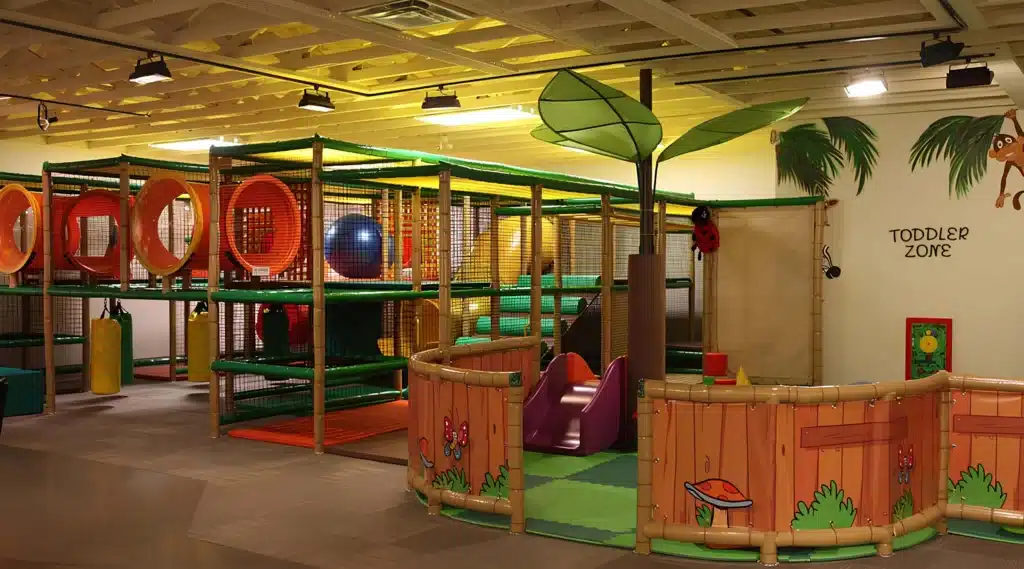
Indoor playgrounds operate under fundamentally different constraints. They are enclosed, climate‑controlled, and subject to building and fire codes. Their materials (foam, vinyl, netting) degrade differently than outdoor steel and wood. And their revenue model depends on maintaining a clean, safe, attractive environment under high‑frequency use.
When capacity is reached indoors, the consequences are often more severe and more immediate than outdoors.
2.1 Fire and Life Safety: Capacity Is Legally Enforced
Unlike outdoor parks, indoor playgrounds have a legal maximum occupancy determined by local building and fire codes (e.g., IBC, NFPA 101). This number is based on:
Floor area and use classification
Number and width of exits
Fire suppression and alarm systems
Exceeding this limit is not a maintenance issue—it is a code violation. Fire marshals can shut down a facility immediately if occupancy is exceeded or if exit paths are blocked by play structures or crowds.
What this means for capacity planning:
The playground layout must not obstruct any exit path, even at peak load.
The facility must have a system (e.g., timed entry, digital counters) to enforce the legal occupancy.
The play structure’s internal capacity (e.g., how many children can safely be inside a multi‑level soft play module) may be lower than the room’s legal occupancy.
Defensible documentation: Include the legal occupancy calculation in the project file. Show that the layout maintains clear egress paths at all times. Document the facility’s crowd‑control procedures.
2.2 Environmental Controls: HVAC, CO₂, and Noise
Outdoor playgrounds have natural ventilation. Indoor playgrounds rely on mechanical systems. When capacity is reached:
CO₂ concentration rises – children breathe heavily during active play. Without adequate air exchange, CO₂ can exceed 1,000 ppm, causing drowsiness, headaches, and increased respiratory infection risk.
Heat and humidity spike – each active child produces significant heat and moisture. An undersized HVAC system will struggle to maintain comfort, leading to complaints and reduced dwell time.
Noise levels become dangerous – indoor surfaces reflect sound. At peak capacity, noise can exceed 85 decibels, causing stress, reduced supervision effectiveness, and potential hearing risk for staff.
What this means for capacity planning:
HVAC must be designed for peak load, not average attendance.
Install CO₂ and noise monitors with audible alerts when thresholds are exceeded.
Consider acoustic treatments (panels, baffles) even if not aesthetically preferred.
Defensible documentation: Obtain HVAC load calculations from a licensed engineer based on expected peak occupancy. Maintain logs of temperature, humidity, and CO₂ readings. Document corrective actions when thresholds are exceeded.
2.3 Material Fatigue Under Repetitive Load
Indoor playground equipment uses soft materials that wear differently than outdoor steel:
Foam compression – soft play padding loses resilience over time. Under peak capacity, foam does not have time to rebound between impacts, accelerating bottoming out. This reduces impact attenuation and can lead to injuries even if the vinyl surface looks intact.
Vinyl and seam failure – high traffic stresses seams and attachment points. Once a seam opens, it becomes a hygiene trap and a tear risk.
Netting stretch – netting used for containment and climbing stretches under load. Stretched netting creates larger openings, increasing entanglement and fall‑through hazards.
What this means for capacity planning:
Establish replacement schedules for soft components based on expected peak usage, not just calendar time.
Conduct regular foam resilience tests (e.g., thumb test or durometer measurement).
Rotate high‑wear zones (e.g., slide exits, ball pit edges) if possible.
Defensible documentation: Keep maintenance logs showing when soft components were installed, inspected, and replaced. Record peak occupancy data to correlate wear with usage.
2.4 Hygiene and Sanitization Under Peak Load
Indoor playgrounds are high‑risk environments for infectious diseases. When capacity is reached:
Surfaces cannot be cleaned during operation – high traffic leaves no gap for spot cleaning.
Bodily fluids (sweat, saliva, minor nosebleeds) accumulate – on vinyl, netting, and in ball pits.
Airborne pathogens circulate – inadequate ventilation concentrates viral particles.
What this means for capacity planning:
Schedule built‑in “rest” periods (e.g., 15 minutes every 2 hours) for deep cleaning of high‑touch surfaces.
Limit ball pit depth and establish regular ball washing cycles.
Require socks and hygiene screening at entry.
Defensible documentation: Maintain cleaning logs with timestamps. Show that the facility has a written sanitation protocol that accounts for peak occupancy conditions.
2.5 Vertical Space and Supervision Blind Spots
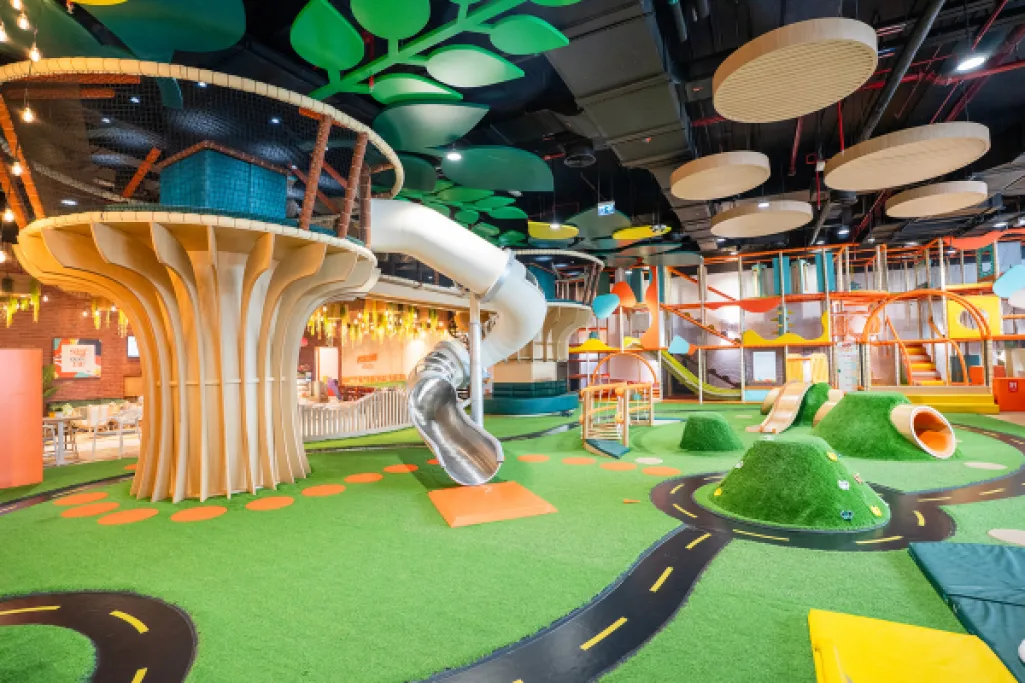
Indoor playgrounds maximize play value by building upward. Multi‑level soft play structures create:
Hidden zones – tunnels, enclosed slides, and netted platforms that are not visible from any single parent vantage point.
Slow evacuation – children inside a crowded structure take time to exit, especially if they must climb down through queues.
What this means for capacity planning:
Limit the number of children allowed inside a multi‑level structure simultaneously (internal capacity, separate from room occupancy).
Use CCTV cameras to monitor blind zones.
Train staff on rapid evacuation procedures.
Defensible documentation: Define internal capacity for each play structure. Post signs at entry points. Maintain camera coverage records and staff training logs.
2.6 Age Separation and Mixed‑Use Zones
Indoor spaces often lack the physical separation that outdoor parks can provide. Toddlers and older children may share the same soft play area. At peak capacity:
Older children move faster and with less awareness of smaller users.
Toddlers are at higher risk of being knocked over or trapped underfoot.
What this means for capacity planning:
Design separate zones for under‑3, 3–5, and 5–12 age groups, with physical barriers (low walls, separate entrances).
If separation is not possible, enforce time‑based or ticketed access for different age groups.
Defensible documentation: Include age‑zone separation in the design brief. Document supervision ratios for each zone.
Part 3: Comparison – Outdoor vs. Indoor Capacity Drivers
| Factor | Outdoor Public Playground | Indoor Commercial Playground |
|---|---|---|
| Legal occupancy limit | None (except for very small enclosed structures) | Enforced by fire code; exceeding is a violation |
| Primary wear indicator | Surfacing displacement/compaction | Foam compression, vinyl tearing, netting stretch |
| Environmental stress | UV, rain, temperature extremes | CO₂, humidity, noise, lack of natural ventilation |
| Hygiene risk | Low (sunlight and air circulation) | High (enclosed, high touch, bodily fluids) |
| Supervision | Open sightlines, caregiver‑dependent | Blind spots in multi‑level structures; requires CCTV and staff |
| Emergency evacuation | Simple (open space) | Complex (children inside nets, tubes, elevated platforms) |
| Capacity documentation | Peak‑load assumptions, circulation plans | Legal occupancy, HVAC load calcs, internal structure limits |
Part 4: A Decision Framework for Indoor Capacity Planning
For indoor facility operators, capacity planning should be documented as a set of peak‑use conditions that the facility must meet. Use the following checklist:
4.1 Legal and Fire Safety
Obtain the legal occupancy limit from the local fire marshal.
Verify that no play structure blocks any exit path or reduces exit width below code.
Post occupancy limits at the entrance and at each play structure entrance.
4.2 HVAC and Air Quality
Confirm that the HVAC system is sized for peak occupancy (not average).
Install CO₂ monitors and set alarms at 1,000 ppm.
Ensure outdoor air intake meets ASHRAE standards for high‑density occupancy.
4.3 Acoustic Comfort
Measure noise levels during peak hours. If exceeding 85 dB, add acoustic panels or limit capacity.
Train staff to recognize noise as a stress indicator.
4.4 Equipment Wear and Maintenance
Establish replacement schedules for foam, vinyl, and netting based on expected peak usage (e.g., foam every 3–5 years, netting every 2–4 years).
Conduct monthly foam resilience tests in high‑wear zones.
Keep spare components on hand for quick replacement.
4.5 Hygiene and Sanitation
Schedule cleaning breaks (e.g., 15 minutes every 2 hours) when the facility is closed to new entries.
Wash ball pits weekly (or more frequently at peak capacity).
Require socks and provide hand sanitizer at entry.
4.6 Supervision and Evacuation
Define internal capacity for each multi‑level structure (e.g., maximum 30 children inside a 500 sq ft soft play module).
Install CCTV cameras covering blind zones.
Conduct monthly evacuation drills with staff.
4.7 Documentation
Keep a written capacity management plan that includes all the above.
Maintain logs of occupancy counts, CO₂ readings, cleaning, inspections, and evacuations.
Review the plan annually and after any major change to the facility or schedule.
Part 5: What Happens When Capacity Is Reached – A Summary
When a playground exceeds its designed capacity, the consequences follow a predictable sequence:
| Stage | Outdoor | Indoor |
|---|---|---|
| First sign | Surfacing displacement, queues at slides | CO₂ rise, noise complaints, foam compression |
| Escalation | Recurring surfacing repairs, minor injuries | Fire marshal warning, customer complaints about air quality, visible wear |
| Failure | Surfacing fails impact test, use zones occupied | Fire code violation, HVAC failure, soft play injury, facility shutdown |
| Cost | Unplanned resurfacing, corrective rework | Legal fines, emergency HVAC repair, premature equipment replacement, lost revenue |
In both environments, the least expensive path is to plan for peak load before procurement. The most expensive path is to react after failure.
Capacity Is a Design Condition, Not a Guess
The question “how many children can this playground handle?” cannot be answered with a single number. It is answered by a set of documented conditions: legal occupancy limits, HVAC performance, material durability, hygiene protocols, supervision coverage, and emergency preparedness.
For outdoor public playgrounds, the focus is on circulation, surfacing, and age separation.
For indoor commercial playgrounds, the stakes are higher. Capacity failures can lead to fire code violations, air quality complaints, accelerated material degradation, and unsafe crowding that makes evacuation impossible. A defensible capacity plan for indoor facilities must include legal occupancy, environmental monitoring, soft material maintenance, and blind‑zone supervision.
Document your assumptions. Test your systems. And when the evidence shows that peak load exceeds the facility’s designed capacity, take action—not because it is easy, but because it is the responsible choice for the children, families, and staff who depend on a safe play environment.