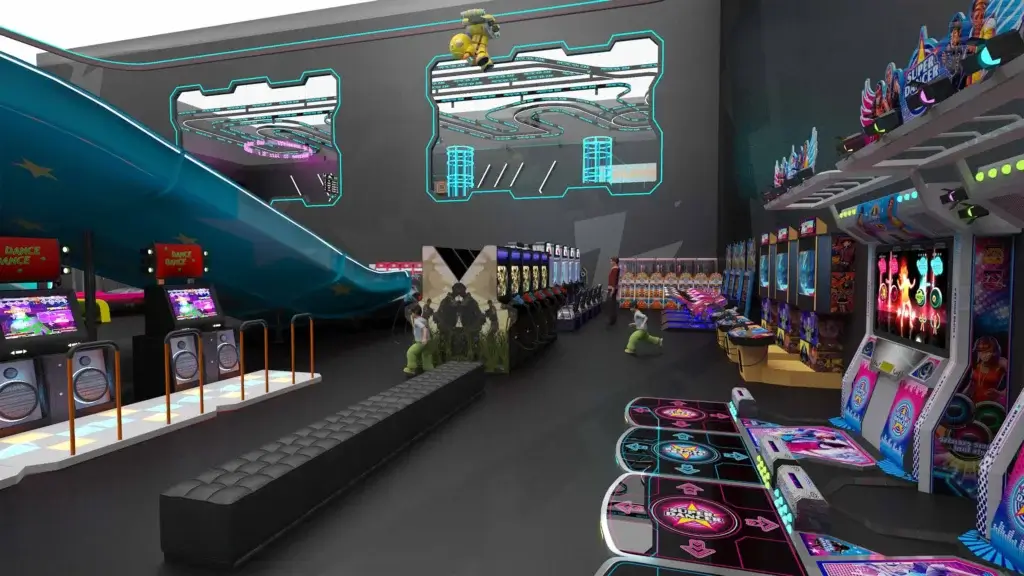
Artificial intelligence is poised to revolutionize the global entertainment industry. While AI has already transformed sectors such as e-commerce, finance, and digital marketing, its impact on location-based entertainment (LBE) is only beginning to emerge. Indoor playgrounds and Family Entertainment Centers (FECs) are particularly well-positioned to benefit from AI technologies, as these venues combine high visitor traffic, repeat engagement, and complex operational demands. AI can enhance both visitor experiences and operational efficiency, enabling entertainment venues to evolve from static play spaces into intelligent, adaptive environments that respond dynamically to user behavior, preferences, and safety needs.
1. AI-Powered Personalized Play Experiences
The traditional playground offers a one-size-fits-all experience—every child encounters the same challenges regardless of age, ability, or interest. AI transforms this paradigm by enabling real-time personalization based on visitor behavior and characteristics.
AI systems can analyze visitor data—including age estimates, movement patterns, and interaction history—and adjust gameplay dynamically to match individual capabilities and preferences. For example:
Younger children receive simplified challenges with gentle pacing, ensuring they experience success without frustration. Interactive walls may display slower-moving targets or larger interactive zones suitable for developing motor skills.
Experienced players receive advanced difficulty levels with faster gameplay, complex problem-solving requirements, or precision-based challenges that maintain engagement and skill development.
Families and groups receive cooperative missions requiring teamwork and communication, transforming individual play into shared experiences. A family might work together to complete a digital treasure hunt spanning multiple play zones, with tasks calibrated to each member’s abilities.
This personalization extends beyond difficulty adjustment. AI systems can learn individual preferences over multiple visits, remembering that a particular child loves climbing challenges but avoids loud noises, or that a family consistently competes in racing games. Over time, the venue becomes increasingly tailored to each visitor, creating a compelling reason for repeat visits.
2. AI-Connected Gameplay Ecosystems
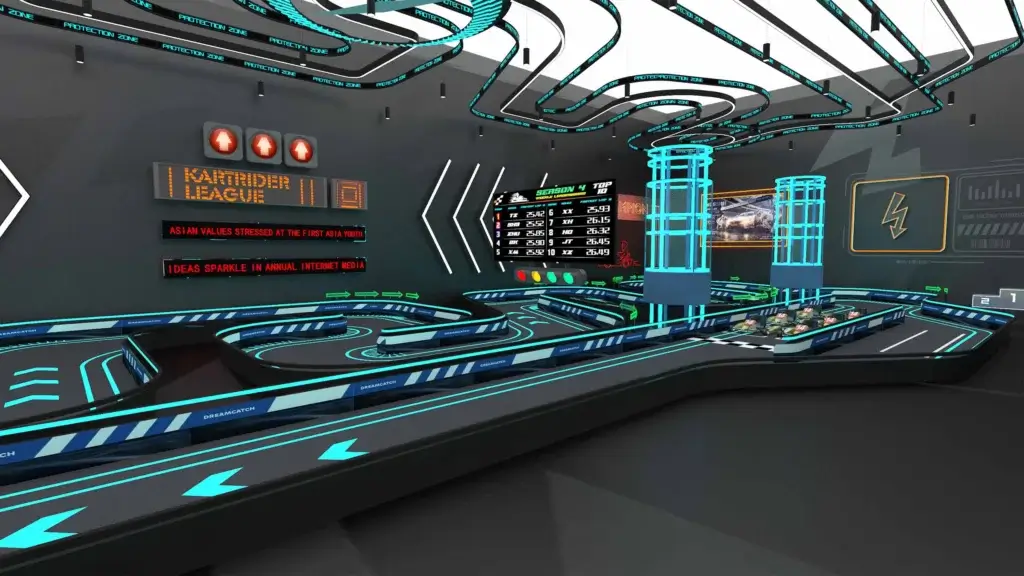
Future entertainment centers may function as connected gaming environments.
Visitors will have digital profiles that track performance across multiple attractions.
Example player metrics:
| Attraction | Recorded Data | Social Potential |
|---|---|---|
| Kart racing | Lap time, position, fastest sector | Compare with friends’ times |
| Climbing wall | Completion time, route difficulty | Challenge others to beat your record |
| VR games | Score, accuracy, completion rate | Share achievements on leaderboards |
| Slides | Speed, style points, trick completion | Compete for fastest descent |
| Interactive floors | Reaction time, game score, calories burned | Team-based cumulative scoring |
| Basketball arcade | Shooting percentage, streak length | Tournament brackets and rankings |
These metrics can be combined into team rankings or leaderboards.
3. Smart Queue Management
Queue management represents one of the most practical applications of AI in entertainment venues. Traditional fixed queues lead to predictable patterns: popular attractions develop long waits while others sit underutilized, frustrating visitors and reducing overall capacity utilization.
AI algorithms can predict peak demand based on historical data, current attendance patterns, and external factors such as weather or local events. These predictions enable dynamic adjustments to queue systems:
Intelligent routing directs visitors to underutilized attractions when wait times exceed thresholds, balancing load across the venue.
Dynamic pricing or reward systems can incentivize visitation to quieter areas during peak times, smoothing demand curves.
Virtual queuing allows visitors to reserve spots at popular attractions via mobile apps, receiving notifications when their turn approaches rather than standing in physical lines.
The benefits extend throughout the venue:
Reduced waiting times improve visitor satisfaction and increase the perceived value of admission.
Improved visitor flow reduces congestion in high-traffic areas, enhancing both safety and experience quality.
Increased attraction utilization ensures that expensive equipment delivers maximum value rather than sitting idle while visitors wait elsewhere.
Staff allocation can be optimized based on predicted demand patterns, reducing labor costs during slow periods while ensuring adequate coverage during peaks.
4. AI-Driven Venue Analytics
Modern entertainment venues generate vast amounts of data, but extracting actionable insights traditionally requires manual analysis that is time-consuming and often incomplete. AI analytics platforms transform this raw data into real-time intelligence that drives operational decisions.
Operators gain visibility into key performance indicators previously difficult to track comprehensively:
Hourly attendance patterns reveal peak periods, enabling precise staffing and maintenance scheduling. If analytics show that Tuesday afternoons consistently attract toddler groups, programming can adjust accordingly with appropriate activities and promotions.
Attraction popularity metrics identify which experiences deliver the highest engagement and which underperform. Angel highlighted this application during her conversation with Claude, noting that operators increasingly want to understand “how many times each game has been played, how many people have entered each area, and which game is actually the most popular.” This data enables evidence-based decisions about when to replace or refresh underperforming attractions.
Revenue pattern analysis reveals which pricing strategies, promotions, and packages generate optimal returns, enabling dynamic adjustment of offers.
Customer demographic insights help operators understand their visitor base and tailor marketing, programming, and facility development to match actual audience composition.
These insights support data-driven decision making across the organization—from daily operational adjustments to long-term strategic planning. When a new attraction is being considered, operators can reference years of data on what has succeeded in their specific context rather than relying on generic industry benchmarks.
5. AI Safety Monitoring
Safety remains the paramount concern in any children’s entertainment environment. Traditional safety approaches rely on staff observation and periodic inspections—both valuable but inherently limited in coverage and consistency. AI-powered computer vision systems dramatically expand safety monitoring capabilities.
Camera systems equipped with computer vision algorithms can continuously monitor attractions and detect potential safety risks in real-time:
Overcrowding detection identifies when any area exceeds safe capacity, triggering alerts before conditions become hazardous. This is particularly valuable for attractions like ball pits, soft play structures, or trampoline courts where density directly impacts injury risk.
Unsafe behavior recognition identifies actions likely to lead to injury—running on elevated platforms, improper sliding positions, climbing outside designated areas—and alerts staff to intervene proactively rather than reactively.
Equipment misuse alerts detect when equipment is being used in ways that could cause damage or injury, enabling immediate correction.
Fall detection systems can identify when a child has fallen and not immediately risen, prioritizing staff response to potential injuries.
These systems enhance safety while reducing staff workload. Rather than requiring constant visual scanning of every area, staff can focus on positive engagement with visitors while AI monitors for exceptions requiring attention. The result is both safer environments and more enjoyable experiences.
6. AI Marketing and Customer Engagement
The relationship with visitors does not end when they leave the venue. AI-powered marketing tools extend engagement throughout the customer lifecycle, personalizing communications to drive repeat visitation and increased lifetime value.
AI systems analyze visitor behavior, preferences, and history to generate highly targeted marketing communications:
Targeted offers reach specific customer segments with relevant promotions. A family that consistently visits for birthday celebrations might receive advance notice of party package enhancements. A teenager who exclusively plays competitive games might receive tournament announcements and leaderboard challenges.
Loyalty rewards can be personalized based on individual visitation patterns and preferences. Rather than generic points programs, AI enables rewards that feel personally meaningful—free access to a favorite attraction, recognition of achievement milestones, or exclusive access to new experiences aligned with demonstrated interests.
Personalized activity suggestions help visitors discover experiences they might enjoy based on their history and similar visitors’ preferences. “Families who enjoyed the climbing wall also loved the aerial course” creates discovery pathways that increase engagement across multiple attractions.
Timing optimization ensures that communications reach customers when they are most likely to respond. AI analyzes past response patterns to determine optimal send times and channels for each customer segment.
These tools improve customer retention and repeat visits by making each visitor feel understood and valued as an individual rather than treated as a generic customer.
7. AI-Generated Digital Memories
In an experience economy, the memory of an event often matters as much as the event itself. AI technologies can automatically generate personalized digital content that captures and extends the visitor experience, creating shareable artifacts that serve both emotional and promotional purposes.
Throughout a visit, AI systems can capture key moments and compile them into polished digital memories:
Replay videos combine footage from multiple angles to create cinematic summaries of key experiences—a child’s triumphant slide descent, a family’s cooperative victory in an interactive game, a competitive kart race finish.
Highlight clips automatically identify peak moments—fastest lap, highest climb, most accurate throw—and compile them into shareable format.
Achievement summaries document all accomplishments during the visit, creating a sense of progress and encouraging return visits to improve performance.
Group compilations bring together highlights from all members of a party, creating shared memories that reinforce social bonds.
Visitors can share these memories on social media platforms, promoting the venue organically while extending their own emotional connection to the experience. A child who receives a professionally edited video of their best moments becomes an ambassador for the venue, sharing content that reaches their entire social network with authenticity that paid advertising cannot match.
For the venue operator, each shared memory represents free promotion with high conversion potential—when friends see genuine enjoyment captured in personalized content, they become more likely to visit themselves.
Conclusion
Building an AI-powered Family Entertainment Center requires a combination of:
strategic planning
innovative design
advanced technology integration
strong operational execution
The future of indoor entertainment is not just about attractions—it is about creating intelligent, connected, and emotionally engaging experiences.
Operators who embrace AI and focus on all-age engagement, data-driven operations, and continuous innovation will lead the next generation of the entertainment industry.