While large-scale, IP-driven Location-Based Entertainment (LBE) venues often capture media attention, the backbone of the indoor and outdoor leisure industry remains the regional Family Entertainment Center (FEC). Funcastle, located in Greencastle, Pennsylvania, serves as a textbook example of a locally owned, resilient FEC that has successfully escaped the commodity trap of the traditional soft-play center. By offering an astutely layered mix of attractions — from 6.5hp Honda-powered Naskarts to professional-grade Iron Mike pitching machines — Funcastle demonstrates how thoughtful commercial indoor play space design, all-age equipment planning, and psychological circulation mapping can maximize per-capita spending and dwell time without relying on expensive licensed IP. This report analyzes Funcastle’s operational logic through the professional lenses of spatial design, amusement equipment planning, and circulation layout, extracting actionable strategic implications for operators and designers worldwide.

1. Commercial Space Design: All-Weather Resilience and Immersive Ambience Switching
Funcastle’s spatial design philosophy revolves around two core concepts: all-weather revenue protection and multi-sensory ambience layering that caters simultaneously to thrill-seeking children and comfort-seeking caregivers.
1.1 Indoor-Outdoor Complementarity
The venue strategically distributes attractions across indoor and outdoor zones to ensure year-round operational viability. The outdoor space, accommodating the family go-kart track (over 1,000 feet with banked turns), Kiddie Track (300 feet), outdoor batting cages, and the 18-hole miniature golf course, leverages natural topography and shade. The terraced hillside mini-golf uses mature trees and gentle slopes to create a relaxed, park-like environment, augmented by the serendipitous auditory cue of a passing train’s horn — a distinct sense of place that no digital screen can replicate.
Conversely, the indoor space — housing the arcade, laser tag arena, indoor batting tunnels, and the snack bar — is repeatedly marketed with the term “air-conditioned.” In commercial space design, air conditioning is not merely climate control; it is a guest retention tool. It transforms the indoor zone into a sanctuary from heat, humidity, and rain, directly extending the average dwell time. This indoor-outdoor dualism ensures that weather disruptions do not collapse daily revenue, a critical lesson in operational risk management for FECs.
1.2 Multi-Layered Atmospheric Design
Rather than applying a single thematic veneer, Funcastle deploys distinct atmospheres for different attraction clusters:
High-Tech Adrenaline: The 2,000 sq. ft. laser tag arena, powered by a Delta Strike system, uses fog, an advanced LED sector system, and power-up mechanics to craft an “out-of-this-world” competitive environment.
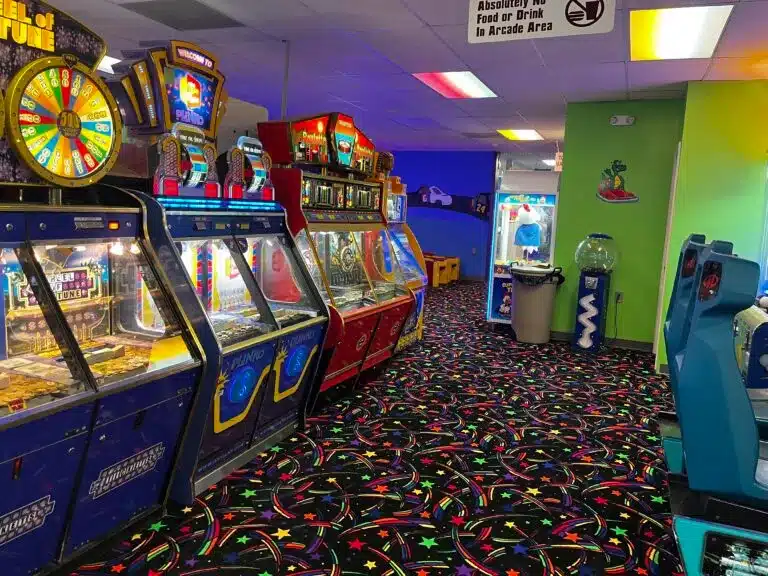
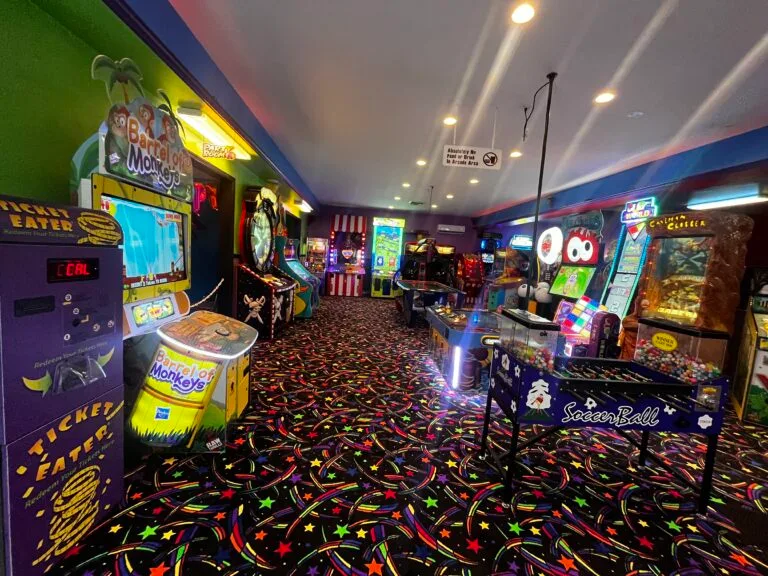
Nostalgic Comfort: The arcade deliberately stocks vintage games, offering Millennial and Gen X parents a powerful emotional anchor. Combined with the snack bar’s classic American fare (Hershey’s Ice Cream, soft pretzels, pizza), this zone evokes a comforting, retro Americana social space.
Pastoral Leisure: The mini-golf course’s large putting surfaces, benches, and tree shade deliberately dial down competitive intensity, offering a gentle decompression space that contrasts with the high-octane karting and laser tag zones.
This deliberate atmospheric switching prevents sensory monotony, allowing guests to self-modulate their arousal levels and stay longer.
2. Amusement Equipment Planning: Granular Age Stratification and Dual-Track Positioning
Funcastle’s equipment selection is a masterclass in all-age targeting that ensures no family member is left without an activity — closing the cohort lifecycle loop that plagues venues focused solely on one age bracket.
2.1 Granular Age Stratification
The venue creates a seamless ladder of engagement:
Ages 2–5 (Toddler): A dedicated Toddler Zone and a weather-dependent Bounce House provide safe, low-stimulus play. The double-seater go-kart also permits passengers as young as three, provided they fit the seatbelt, allowing the youngest children to participate in the “racing” narrative alongside parents.
Ages 7+ (Youth): The laser tag arena opens, introducing cooperative and competitive team play with a high-tech frame.
Ages 10+ / 56” (Older Children): Unlocks the independent driving experience of single-seat karts with 6.5hp Honda engines and hydraulic brakes, providing genuine mechanical thrill.
Age 16+ with License (Adults): Permits driving the double-seater karts with a passenger, positioning adults as active participants rather than passive observers.
This layering solves the fundamental FEC problem: a family with children aged 3, 8, and 13 can visit together, and every child finds a developmentally appropriate, thrilling activity without compromising safety. The design closes the “age gap” that often forces families to go elsewhere.
2.2 Professional Training Meets Casual Play
While most FECs stop at casual leisure, Funcastle operates a 2,500 sq. ft. indoor, air-conditioned batting tunnel facility equipped with Master Pitch’s Iron Mike arm-type pitching machines, offering speeds of 40, 65 MPH and slow/fast-pitch softball. These machines mimic the natural throwing motion of a human arm, the industry standard for serious training. By incorporating this professional-grade equipment, Funcastle’s business model pivots from a purely transactional leisure venue to a community training hub. This attracts local athletes, school teams, and private coaching sessions, creating a high-frequency, recurring revenue stream that is far less seasonal than birthday parties alone.
2.3 The Internal Gamified Redemption Economy
Funcastle’s arcade redemption system is engineered as a cross-attraction loyalty loop. Tickets won from skill and video games can be redeemed not only for merchandise but also for free golf and go-kart rides. This creates a closed-loop token economy: arcade play fuels outdoor attractions, which in turn drive the need to return to the arcade for more tickets. This inter-equipment linkage transforms a collection of independent revenue centers into a synergistic ecosystem, increasing per-guest spend across categories.
3. Circulation and Layout: Hub-and-Spoke, Dynamic-Static Zoning, and Caregiver Anchors
While a site plan is not publicly available, the attraction inventory strongly suggests a classic hub-and-spoke circulation model with a sophisticated understanding of psychographic zoning.
3.1 The Snack Bar and Arcade as Central Hub
The indoor snack bar and arcade likely function as the physical and financial pivot of the venue. These zones sit at the intersection of all guest flows. The high-margin F&B operation is thus placed directly in the path of every transition: families refuel between laser tag and mini-golf, or parents settle here as their base of operations while children rotate through active attractions. This design maximizes exposure to food sales — the highest-margin category in the FEC business.
3.2 Dynamic vs. Static Zoning for Psychographic Flow
Funcastle spatially segregates attractions by energy demand:
High-Energy / High-Noise Zone: Go-karts (engine noise, tire friction), batting cages (impact sounds), and laser tag (darkness, shouting) are logically placed outdoors or in acoustically contained indoor rooms. This prevents auditory bleed that would otherwise fatigue guests in the relaxation zones.
Low-Energy / Restoration Zone: Mini-golf (walking, light concentration) and the air-conditioned snack bar seating act as psychological recovery nodes. The guest journey can naturally flow from the high-arousal karting experience to the low-arousal garden putting, and then to the snack bar for refueling. This self-regulated flow is crucial for extending dwell time well beyond the 90-minute mark typical of a single-mode attraction.
3.3 Strategically Placed Caregiver “Dwell Nodes”
Perhaps the most operationally brilliant design element is the deliberate placement of comfort features for non-playing companions. The mention of “benches placed on the course” and “large trees to provide shade” on the mini-golf course, and the emphasis on “inside (air-conditioned) seating” in the snack bar, are not incidental. They are caregiver dwell anchors. A parent who can sit comfortably in the shade with a coffee, or in a cooled booth, while visually monitoring their child, will not agitate to leave. This passive comfort is the single most powerful lever for increasing total party dwell time, which directly correlates with higher food, beverage, and replay sales.
4. Strategic Takeaways for FEC Design and Equipment Planning
For operators and designers building regional or suburban FECs, Funcastle offers a replicable, high-margin blueprint that eschews expensive media IP in favor of solid design fundamentals:
Layer, Don’t Niche. Avoid the trap of designing for a single age band. Engineer a granular equipment ladder that allows a multi-child family to grow within your venue from toddlerhood to the teen years. A 6.5hp go-kart for a 10-year-old and an Iron Mike cage for a 16-year-old athlete are retention tools, not just attractions.
Design an Internal Token Economy. Link disparate attractions through a unified redemption currency. The simple act of allowing arcade tickets to be converted into a free go-kart ride transforms a cost center into a traffic driver. Equipment should not exist in isolation; plan the digital or physical gamification layer that connects them.
Prioritize the Caregiver Sanctuary. The air-conditioned snack bar with clear sightlines to the play areas is not secondary real estate — it is the economic engine. If the paying parent is hot, uncomfortable, or bored, the entire family leaves. Professional-grade F&B and comfort seating are the ultimate dwell-time maximizers.
Incorporate Professional-Grade Anchors. Adding a single, professionally specified sports training facility (like indoor batting tunnels with arm-type pitching machines) shifts the business model from episodic leisure visits to recurring, committed training sessions. This creates weekday revenue and a defensive moat that a pure “play-for-fun” center cannot easily breach.
Conclusion: The Post-Scroll Entertainment Model
Funcastle’s operational thesis rejects the notion of the FEC as a warehouse of isolated amusements. Instead, it synthesizes a coherent entertainment ecosystem where spatial design, equipment tiering, and reward mechanics interlock. For developers in the regional LBE sector, the key takeaway is the necessity of dwell-time architecture: integrating athletic academies for weekday cash flow, building climate fortresses for parental comfort, and weaving a unified redemption economy that turns arcade tickets into the facility’s internal currency. In an era of digital distraction, Funcastle proves that sticky, repeat visitation is engineered not just through the attraction itself, but through the seams between them.