Choosing commercial indoor playground equipment is one of the most important decisions when planning an indoor playground, family entertainment centre (FEC), shopping mall play area, or children’s entertainment venue.
The equipment you select will influence far more than the appearance of your facility. It affects the visitor experience, operating capacity, safety management, maintenance costs, space utilization, customer satisfaction, and long-term profitability.
For Canadian investors, the challenge is that the market offers many different options, from modular soft play equipment and multi-level playground structures to trampolines, climbing attractions, interactive games, and themed role-play areas. Comparing these options by price or appearance alone can lead to expensive mistakes.
The best commercial indoor playground equipment is not necessarily the largest, most elaborate, or cheapest option. It is the equipment that matches your business model, target customers, building conditions, safety requirements, operating budget, and long-term growth plans.
This guide explains how to evaluate equipment types, establish your requirements, compare manufacturers, assess safety documentation, and make a more informed purchasing decision in Canada.
Understand Your Business Model Before Choosing Equipment
Before looking at equipment catalogues or requesting quotations, define the business you intend to operate.
Different venues have different customers, space constraints, operating patterns, and revenue models. These differences should determine your equipment selection.
Indoor playgrounds for independent operators
An independent indoor playground typically serves families with young children and generates revenue through admission fees, memberships, birthday parties, and additional services.
Suitable equipment may include:
Slides, tunnels, and climbing obstacles
Ball pits and interactive play elements
Toddler play areas
Pretend-play and role-play equipment
Birthday party rooms and supporting activity areas
For this business model, the objective is to create an engaging play environment that encourages repeat visits while remaining manageable to operate and maintain.
A large structure filled with activities may look impressive, but it is not automatically the most profitable solution. The layout must also support supervision, circulation, cleaning, capacity management, and birthday party operations.
Family entertainment centres
A family entertainment centre generally serves a broader age range and may combine several entertainment formats.
Depending on the target market, the equipment mix could include:
Large indoor playground structures
Trampoline attractions
Ninja courses and climbing challenges
Interactive games
Arcade or skill-based attractions
Dedicated toddler zones
FEC operators should consider how different attractions complement one another. A facility with several distinct experiences may appeal to a wider audience than one dominated by a single attraction type.
However, adding more equipment does not automatically increase profitability. Every attraction requires space, capital, maintenance, supervision, and potentially additional safety procedures.
The equipment plan should support the overall entertainment concept rather than simply maximize the number of attractions.
Shopping mall and mixed-use developments
A shopping mall play area may be designed to increase family visits, encourage longer stays, and strengthen the property’s appeal to parents with children.
Equipment selection should reflect:
Available footprint and ceiling height
Visibility from surrounding retail areas
Integration with the mall’s design
Expected visitor volume
Access control and supervision arrangements
Noise, cleaning, and maintenance requirements
Whether the area is free, paid, or linked to a commercial operator
A compact, visually distinctive play area may be more appropriate than a large multi-level structure if the space is intended to complement nearby retail and food-service businesses.
Play cafés, hotels, and hospitality venues
These businesses often need equipment that complements another primary activity, such as dining, accommodation, or leisure.
Typical priorities include:
Compact and efficient layouts
Age-appropriate play activities
Materials that are practical to clean
Clear visibility for parents and staff
Equipment that complements the venue’s interior design
Manageable maintenance requirements
In these settings, the best equipment may be a carefully selected collection of play elements rather than a complete indoor playground structure.
Daycares, schools, and community facilities
Educational and childcare environments have different priorities from commercial entertainment venues.
Equipment selection may need to reflect licensing requirements, educational objectives, age suitability, supervision practices, accessibility, and institutional procurement procedures.
If the facility will provide regulated childcare, do not assume that equipment suitable for a commercial indoor playground automatically meets every applicable childcare requirement. Confirm the requirements with the relevant provincial or territorial authority.
The first purchasing principle is simple: choose equipment for the business you are building, not just the space you have available.
Choose Equipment Based on Your Target Age Groups
Children at different developmental stages interact with playground equipment differently. A successful equipment plan should reflect these differences.
Toddlers and very young children
Younger children generally benefit from activities that encourage exploration, balance, coordination, and early physical development.
Potential equipment includes:
Low-height climbing structures
Soft play blocks
Small slides
Sensory panels
Crawling tunnels
Interactive wall games
Soft obstacles and stepping elements
The design should consider appropriate play heights, accessible entry and exit points, fall protection, and the need for close adult supervision.
A dedicated toddler zone can also make the facility more comfortable for families with children of different ages.
Preschool children
Preschool children often enjoy a combination of physical challenges, imaginative play, and activities that allow them to explore independently within a supervised environment.
Suitable options may include:
Slides and climbing nets
Ball pits
Themed role-play areas
Interactive games
Balance and coordination challenges
The equipment should offer enough variety to support repeat visits without creating unnecessary complexity for operators.
School-age children
Older children may look for more challenging and varied activities.
Depending on the venue, suitable attractions can include:
Larger climbing structures
Multi-level obstacle courses
Ninja-style challenges
Interactive projection games
Trampolines
Adventure-themed attractions
Competitive or cooperative games
For mixed-age facilities, the goal is not simply to separate children by age. It is to design a play environment in which different activities can operate safely and comfortably within the same overall venue.
Should you separate play areas by age?
In many cases, separate zones can improve the visitor experience and simplify supervision.
For example, a facility might include a toddler area, a main playground for preschool and school-age children, and a separate high-energy attraction zone.
However, age labels alone do not determine whether equipment is suitable. Actual suitability depends on the equipment’s design, intended users, applicable standards, layout, supervision, and operating procedures.
Before purchasing, ask the supplier to explain the intended age range for each attraction and how the proposed design addresses foreseeable use by children of different sizes and abilities.
Understand the Main Types of Commercial Indoor Playground Equipment
Once you have defined your business model and target audience, you can compare equipment categories.
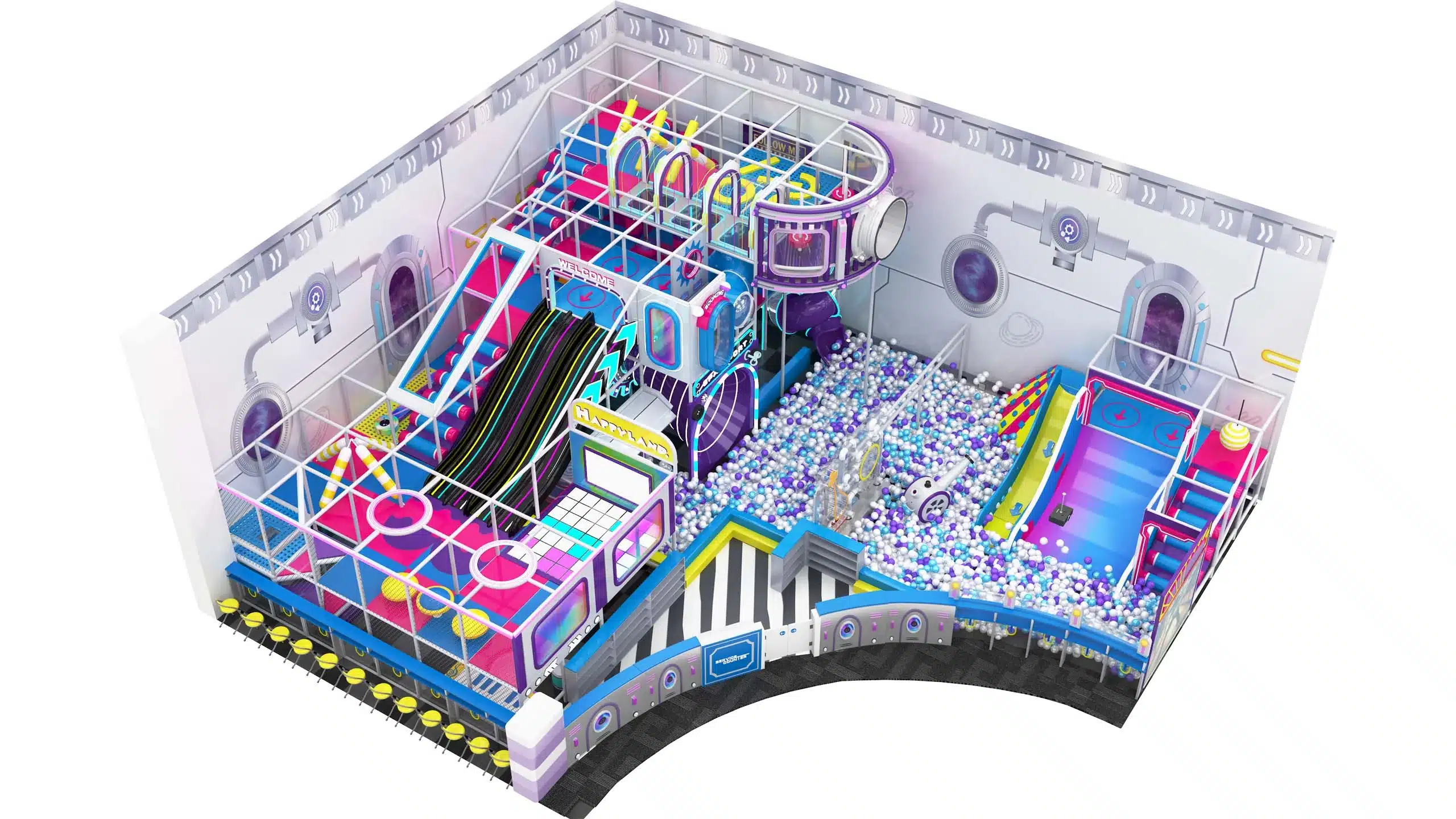

Multi-level indoor playground structures
Multi-level structures are common in commercial indoor playgrounds because they combine several activities within a relatively compact footprint.
Typical elements include:
Best suited for: Independent indoor playgrounds, FECs, shopping malls, and larger family entertainment venues.
Key considerations: Ceiling height, circulation, visibility, entry and exit points, maintenance access, structural support, and the relationship between equipment capacity and the overall venue capacity.
A multi-level structure should be designed around the actual building rather than selected from a catalogue without considering site conditions.
Soft play equipment
Soft play equipment uses padded components and other appropriately designed play elements to support physical exploration and active play.
It can include foam blocks, soft climbing units, padded obstacles, crawl-through elements, and toddler activity modules.
Best suited for: Toddler zones, play cafés, childcare environments where permitted, and facilities serving younger children.
Key considerations: Upholstery durability, seam construction, cleanability, foam performance, material documentation, and the condition of surfaces under frequent use.
Commercial use can subject soft play components to intensive wear. The initial appearance of a product is therefore less important than its construction quality and long-term maintainability.
Slides, ball pits, and interactive play elements
These components can add variety to a larger structure or form part of a smaller play area.
When comparing them, consider how they connect to surrounding activities, how children enter and leave the attraction, how staff can supervise use, and how the components can be cleaned and inspected.
A feature that looks attractive in a product photograph may not perform as expected if it creates congestion or is difficult to access for maintenance.
Trampolines and high-energy attractions
Trampolines, climbing challenges, and other high-energy attractions can appeal to older children and expand the range of experiences offered by an FEC.
However, they should be treated as distinct attraction categories rather than simply additional pieces of playground equipment.
Before purchasing, review the relevant product-specific safety requirements, operational controls, inspection procedures, staffing needs, and insurance implications.
The equipment supplier should clearly identify the intended use and applicable documentation for each attraction.
Role-play and themed equipment
Role-play areas allow children to engage in imaginative activities such as shopping, cooking, building, or pretending to work in different professions.
Themed environments can also strengthen the identity of a commercial venue and create more distinctive visitor experiences.
Examples include miniature shops, construction-themed play areas, themed houses, and imaginative adventure environments.
Best suited for: Play cafés, family entertainment centres, shopping malls, and venues seeking a differentiated concept.
Themed equipment should be evaluated for more than its visual appeal. Consider durability, replacement parts, cleaning, access, and whether the theme can remain attractive over several years.
Interactive and technology-enabled equipment
Interactive attractions may incorporate digital games, projection systems, sensors, or other technology-based experiences.
They can provide variety and encourage repeat engagement, particularly in venues serving older children.
Before investing, evaluate:
Reliability of the technology
Software or content update requirements
Repair and replacement costs
Power and network requirements
Availability of technical support
Whether the technology requires recurring fees
How the attraction fits the overall customer experience
Technology should solve a clear business or visitor-experience problem rather than be added simply because it is new.
Compare Total Project Cost, Not Just Equipment Price
One of the most common purchasing mistakes is selecting equipment before confirming the building’s practical limitations.
A commercial indoor playground must fit the actual premises, including its circulation routes, building services, structural conditions, and operational requirements.
Measure the usable floor area
Start with an accurate floor plan showing:
Total leased area
Columns and structural walls
Entrances and exits
Windows and doors
Washrooms
Electrical and mechanical rooms
Fire exits and required circulation routes
Reception and admission areas
Party rooms
Café or seating areas
Storage and staff spaces
The total leased area is not the same as the area available for play equipment.
A commercially effective layout must also accommodate parents, staff, circulation, storage, cleaning, and other supporting functions.
Confirm ceiling height and overhead obstructions
Ceiling height can significantly affect equipment selection.
Before approving a layout, identify:
Clear ceiling height
HVAC ducts
Sprinkler heads and piping
Lighting fixtures
Structural beams
Cable trays and other services
Maintenance access requirements
A structure that fits the floor plan may still be unsuitable if the available vertical clearance is insufficient.
Ask the supplier to confirm the required installation height and the clearances assumed in the design.
Check structural and building conditions
Depending on the equipment and building, the project may require professional review of floor loading, anchoring, structural supports, and other building conditions.
Do not assume that a floor can support a proposed installation simply because it is a commercial building.
Before committing to a design, coordinate with the landlord, architect, structural engineer, contractor, and relevant authorities as appropriate.
Plan circulation, visibility, and supervision
Equipment placement should allow staff to supervise children effectively and help visitors move through the facility without unnecessary congestion.
Consider:
Clear routes between major attractions
Access to entrances and exits
Staff sightlines
Areas where children may be temporarily out of view
Parent seating and observation points
Access for cleaning and repairs
Emergency access and evacuation arrangements
The supplier’s drawings should show the proposed equipment layout and relevant clearances, not merely the overall dimensions of the structure.
Consider future expansion
If the business performs well, you may want to introduce new attractions, replace worn components, or refresh the theme.
Ask whether the proposed system is modular and whether future changes would require extensive reconstruction.
A design that allows practical upgrades can help operators manage long-term capital expenditure.
Make Safety and Compliance a Purchasing Priority
Commercial indoor playground equipment is intended for use by the public, often under conditions of frequent use and limited direct supervision of every individual activity.
Safety should therefore be part of the purchasing specification from the beginning, rather than a final check after the design has been completed.
Identify the standards applicable to your project
The appropriate standards depend on the equipment category, intended users, jurisdiction, and project requirements.
For example, ASTM F1918 addresses soft contained play equipment, while ASTM F1487 addresses public-use playground equipment. Other attraction categories may require different standards or technical requirements.


In Canada, buyers should identify the relevant Canadian standards and local requirements for their particular installation. Do not assume that a reference to ASTM, CSA, EN, CE, or TÜV automatically establishes compliance with every requirement applicable to a project.
The US Consumer Product Safety Commission’s playground equipment guidance and the International Play Equipment Manufacturers Association’s certification information can help buyers understand some of the distinctions between equipment categories and certification scopes. They should not, however, be treated as substitutes for project-specific Canadian compliance review.
Ask for documentation that matches the actual equipment
Before placing an order, request the relevant technical and safety documentation.
Depending on the equipment, this may include:
Product specifications and model identification
Applicable standards and editions
Test reports or conformity documentation
Structural calculations and engineering drawings where relevant
Materials specifications
Fire-performance documentation where applicable
Electrical documentation for powered attractions
Installation instructions
Inspection and maintenance manuals
Confirm that the documentation covers the equipment and configuration being purchased, rather than a different model or a general product category.
A certificate or report should be evaluated according to its actual scope. A factory quality-management certificate, for example, is not the same thing as a product safety test report.
Examine fall protection and potential hazards
Depending on the attraction, the design review may need to consider:
Fall heights and impact protection
Openings and potential entrapment hazards
Gaps between components
Guardrails and barriers
Access and exit points
Moving parts
Collision and congestion risks
Surfacing and landing areas
Visibility and supervision
The applicable criteria should be established by qualified professionals and the relevant standards, not by relying on a generic supplier checklist alone.
Evaluate material performance
Commercial play equipment must withstand frequent use, cleaning, and repeated physical contact.
Ask suppliers about the specifications and performance of the materials used in the actual equipment.
Relevant materials may include metal frames, wood-based panels, foam, PVC, upholstery, netting, plastics, adhesives, coatings, and flooring.
Consider durability, cleanability, repairability, and the suitability of the materials for the intended environment.
Where fire performance, chemical composition, or other regulated characteristics are relevant, request the appropriate supporting documentation rather than relying on broad marketing claims.
Review accessibility and inclusive design
Accessibility requirements depend on the applicable building regulations, accessibility legislation, facility type, and jurisdiction.
Even where a particular design feature is not explicitly required for every attraction, inclusive design can improve the experience for a wider range of families.
When planning the layout, consider accessible routes, entrance arrangements, seating, circulation, and opportunities for children with different abilities to participate.
Accessibility should be reviewed as part of the overall facility design, not left entirely to the equipment supplier.
Compare Equipment Quality and Long-Term Durability
Two structures may look similar in photographs while differing significantly in construction, materials, engineering, and maintenance requirements.
To compare products meaningfully, request technical specifications rather than relying only on catalogue images or promotional videos.
Structural components
Ask about the materials, dimensions, protective finishes, connections, anchoring arrangements, and engineering assumptions relevant to the proposed installation.
The suitability of structural components depends on the equipment design and site conditions. Where necessary, have the relevant technical information reviewed by a qualified professional.
Soft play and upholstery
For padded components, review:
Foam and padding specifications
Cover materials
Seam construction
Abrasion resistance
Cleaning instructions
Repair procedures
Replacement-part availability
These details are particularly important in high-traffic facilities where components may experience continuous wear.
Nets, ropes, and connection points
For structures that use nets, ropes, or similar components, ask how they are attached, inspected, maintained, and replaced.
The supplier should provide practical maintenance instructions and identify the components that may require periodic replacement.
Modularity and replacement parts
A modular design can make it easier to replace damaged components or update parts of the playground without rebuilding the entire structure.
Ask the supplier to identify:
Components that can be replaced individually
Spare parts that can be ordered later
Typical replacement procedures
Availability of technical drawings
Whether future parts will remain compatible with the original system
Long-term parts availability matters because commercial playground equipment is a capital investment, not a short-term consumer purchase.
Choose a Theme That Supports Your Business Strategy
A themed playground can help distinguish your venue from competing entertainment options, but the theme should support the business model rather than dictate every design decision.
Start with your target market
Consider the families you want to attract and the experience they are likely to value.
A construction theme may suit a venue focused on imaginative building activities. An adventure theme may be appropriate for an FEC serving older children. A nature-inspired design may fit a family-oriented venue seeking a calmer visual environment.
The best theme is one that appeals to your intended customers while remaining practical to manufacture, install, clean, and maintain.
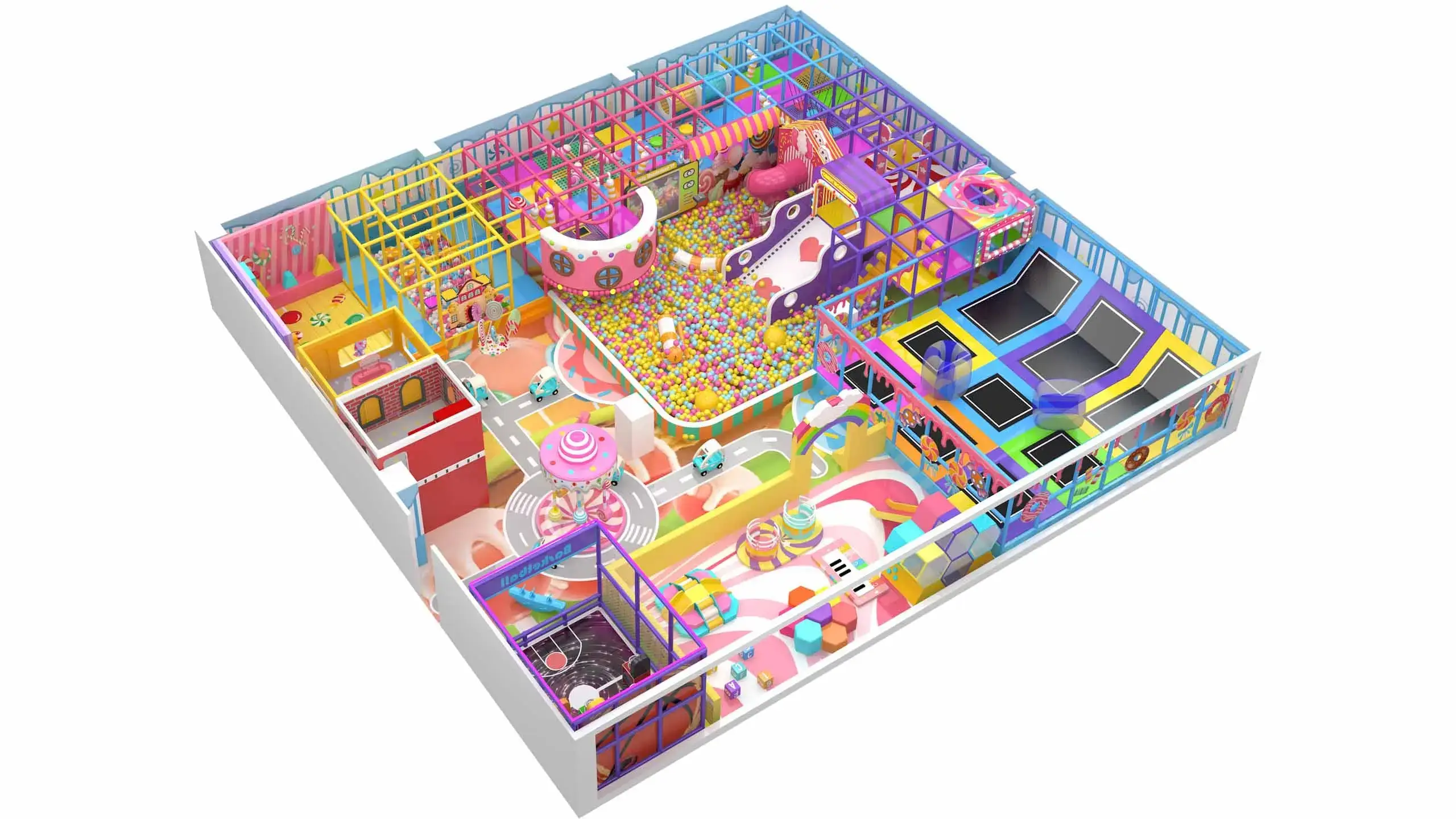

Balance visual impact with play value
A distinctive design can attract attention in photographs, promotional videos, and social media content.
However, visual impact should not come at the expense of usability.
Evaluate how the theme affects the variety of activities, visibility, movement, supervision, durability, and future modification.
Plan for long-term relevance
Some themes depend heavily on temporary trends or specific licensed characters. Others can remain attractive for longer periods.
Before selecting a theme, consider whether you can refresh its appearance without replacing the entire structure.
A design that supports selective upgrades may offer greater long-term flexibility.
Evaluate the Manufacturer and Supplier Carefully
Choosing the right equipment is only part of the purchasing decision. You also need a supplier capable of delivering the agreed design, documentation, equipment, and support.
Manufacturer versus trading company
A manufacturer may provide direct access to production specifications, customization, engineering coordination, and component replacement.
A trading company may offer a broader catalogue or coordinate equipment from multiple manufacturers. This can be useful for projects requiring products from several sources.
Neither business model is automatically better in every situation. The important question is whether the supplier can demonstrate responsibility for the equipment and services included in your contract.
Ask who will manufacture the products, who is responsible for design changes, who supplies the technical documentation, and who will resolve problems if a component does not meet the agreed specification.
Manufacturing capability
If you are considering a manufacturer, ask for evidence of its actual production capabilities.
Useful information may include:
Factory and production-process information
Quality-control procedures
Product specifications
Custom design capabilities
Relevant testing and documentation
Production planning and lead times
Packaging and shipping arrangements
References from comparable projects
A factory tour or production video can help you understand the manufacturing process, but it should be considered alongside technical documentation and contractual commitments.
Design and engineering support
For a custom indoor playground, the supplier should be able to translate your requirements into a practical layout and equipment specification.
Depending on the project, deliverables may include:
2D layouts
3D visualizations
Equipment dimensions
Technical drawings
Installation plans
Equipment schedules
Site-specific coordination documents
Clarify which deliverables are included in the quotation, which are preliminary, and which will be issued for final approval.
Installation and project coordination
A supplier may offer equipment only, installation support, or a more comprehensive project delivery service.
Before signing, establish who is responsible for:
Site measurements and design coordination
Production and delivery scheduling
Shipping and customs documentation
Site preparation
Equipment anchoring
Final inspection and handover
Maintenance documentation
For international purchases, clarify which costs and responsibilities belong to the supplier and which belong to the Canadian buyer, contractor, or other project partners.
After-sales service
Ask how the supplier will support the equipment after installation.
Questions should include:
How are warranty claims submitted?
Which components are covered, and for how long?
What exclusions apply?
Are spare parts available?
How are replacement components ordered?
What technical support is provided?
What documentation is supplied for inspections and maintenance?
A long warranty is not necessarily valuable if the exclusions are broad, spare parts are unavailable, or the claims process is unclear.
Review comparable projects
Ask to see projects that resemble yours in scale, equipment type, customer profile, and operating environment.
Look beyond attractive finished photographs. Where possible, request information about the scope of work, equipment supplied, installation arrangements, and how the project was delivered.
Relevant project experience can help you assess whether the supplier understands the practical challenges of your type of venue.
Evaluate the Manufacturer and Supplier Carefully
One of the most important purchasing principles is to compare quotations on the same basis.
A supplier quoting only the equipment may appear less expensive than a supplier providing equipment, installation, and additional project services. The difference may reflect a genuine price advantage, a different scope, or costs that have simply not been included.
Understand the main cost categories
Depending on the project, the total investment may include:
| Cost category | What to verify |
|---|---|
| Equipment | Products, quantities, specifications, and included accessories |
| Design | Concept design, layout, 3D visualization, and technical drawings |
| Shipping | Packaging, freight, delivery arrangements, and insurance |
| Import costs | Applicable duties, taxes, brokerage, and customs-related charges |
| Installation | Labour, travel, equipment assembly, and anchoring |
| Site preparation | Flooring, electrical work, building modifications, and other trades |
| Safety and inspection | Required professional reviews, testing, and inspections |
| Spare parts | Initial spare components and replacement-part arrangements |
| Maintenance | Cleaning supplies, routine inspections, repairs, and replacement components |
Not every project will require every item, and the amounts will vary according to location, building conditions, and the agreed scope of work.
Request an itemized quotation
A useful quotation should identify the equipment, quantities, dimensions, materials, specifications, and services being supplied.
For custom projects, ask the supplier to clarify whether the price is based on a preliminary concept or an approved final design.
You should also confirm payment milestones, production lead time, shipping terms, installation arrangements, warranty provisions, and the process for approving changes.
Calculate the total cost of ownership
The purchase price is only one part of the financial decision.
Over time, you may also incur costs for cleaning, inspections, repairs, replacement parts, technology updates, and equipment refreshes.
A product with a lower initial price may not represent better value if it requires more frequent repairs or has limited replacement-part availability.
When comparing quotations, consider both the initial capital cost and the likely ongoing costs over the period you expect to operate the facility.
Evaluate Equipment Through the Lens of Revenue and Customer Experience
Equipment should support the commercial objectives of your venue, but its contribution to revenue depends on how the entire business operates.
Think about repeat visits
A playground with a varied range of activities may offer more reasons for families to return than one built around a single attraction.
However, repeat visits also depend on cleanliness, customer service, convenience, pricing, programming, and the overall family experience.
Equipment selection should therefore be evaluated as part of a complete operating strategy.
Consider birthday parties and group bookings
Birthday parties can be an important revenue stream for many indoor playgrounds and FECs.
When selecting equipment and planning the layout, consider how the facility will accommodate party guests, parent seating, food service, movement between activities, and access to party rooms.
The objective is to make group visits convenient without creating unnecessary congestion for general admission customers.
Balance play capacity and operating capacity
A structure’s theoretical capacity is not necessarily the number of children your entire venue can safely accommodate at one time.
Practical capacity depends on the equipment design, applicable requirements, circulation, supervision, staffing, emergency arrangements, and the layout of the wider facility.
Ask the supplier to explain any stated capacity figures and the assumptions behind them. Then evaluate those figures in the context of your complete operating plan.
Consider the parent experience
Parents influence where families choose to visit and whether they return.
A well-planned venue should consider seating, visibility, convenient circulation, washroom access, food and beverage options where appropriate, and the ease of supervising children.
These elements are not substitutes for good equipment, but they can determine how well the overall facility performs.
Avoid purchasing equipment based on projected revenue alone
Be cautious of supplier claims that a particular attraction will generate a specific revenue amount without clearly explaining the assumptions.
Actual financial performance depends on admission prices, customer volume, operating hours, occupancy, staffing, local competition, rent, marketing, and many other factors.
Evaluate equipment as one part of a broader financial model rather than assuming that more attractions automatically produce a higher return.
Common Mistakes When Buying Commercial Indoor Playground Equipment
Understanding common purchasing mistakes can help you avoid unnecessary costs and delays.
Mistake 1: Choosing equipment before defining the concept
Selecting products first can lead to a fragmented layout that does not support the intended customer experience.
Better approach: Define the business model, target age groups, attraction mix, and operating objectives before finalizing the equipment specification.
Mistake 2: Comparing suppliers only by price
Different quotations may cover different equipment, documentation, shipping, installation, and support.
Better approach: Establish a common specification and compare itemized quotations on an equivalent scope.
Mistake 3: Treating marketing claims as compliance evidence
General claims such as “internationally certified” or “meets all safety standards” do not necessarily demonstrate compliance for your specific installation.
Better approach: Identify the applicable requirements and request the relevant documents for the actual equipment being purchased.
Mistake 4: Ignoring building constraints
A design may be attractive but unsuitable for the premises because of ceiling height, structural conditions, mechanical services, or circulation requirements.
Better approach: Confirm site conditions and coordinate with the relevant professionals before approving the final design.
Mistake 5: Underestimating maintenance
Commercial equipment experiences repeated use and will require inspection, cleaning, and eventual replacement of worn components.
Better approach: Review maintenance instructions, warranty exclusions, spare-part availability, and replacement procedures before purchasing.
Mistake 6: Choosing a theme without considering operations
A visually impressive theme may create unnecessary maintenance complexity or make future changes difficult.
Better approach: Evaluate appearance alongside durability, cleaning, accessibility, repairability, and long-term flexibility.
Mistake 7: Failing to clarify project responsibilities
Problems can arise when the contract does not clearly identify who handles installation, site preparation, technical approvals, shipping, and final handover.
Better approach: Establish responsibilities in writing and confirm the complete scope before production begins.
A Practical Checklist for Choosing Commercial Indoor Playground Equipment
Use the following checklist when evaluating suppliers and preparing a purchase decision.
Business requirements
Define the business model and target customers.
Identify the intended age groups.
Establish the expected visitor experience.
Determine the desired mix of attractions.
Define the available capital budget.
Identify the expected opening timeline.
Site and layout
Obtain accurate site measurements.
Confirm usable floor area and clear ceiling height.
Identify columns, building services, and structural constraints.
Review access, circulation, and emergency arrangements.
Confirm the proposed equipment layout.
Review supervision and visibility.
Consider maintenance access and future expansion.
Safety and documentation
Identify the applicable standards and requirements.
Request documentation relevant to the actual equipment.
Review the intended age range and use conditions.
Confirm material specifications and relevant test documentation.
Review installation requirements and anchoring details.
Obtain inspection and maintenance instructions.
Confirm whether additional professional reviews or approvals are required.
Supplier evaluation
Clarify whether the supplier is the manufacturer or a trading company.
Review relevant manufacturing capabilities.
Request comparable project references.
Evaluate customization and design support.
Confirm production and delivery lead times.
Clarify installation responsibilities.
Review warranty terms and exclusions.
Confirm spare-part availability and after-sales support.
Financial evaluation
Obtain itemized quotations.
Compare equivalent equipment specifications.
Identify design, shipping, import, and installation costs.
Account for site preparation and other contractors.
Review maintenance and replacement costs.
Confirm payment terms and change-order procedures.
Evaluate the investment within the broader business plan.
Before placing the order
Approve the final layout and equipment specification.
Confirm all agreed deliverables in writing.
Review the contract and payment milestones.
Clarify delivery, installation, and handover procedures.
Confirm the documentation required before opening.
Establish a plan for ongoing inspection and maintenance.
A Step-by-Step Purchasing Process
For many investors, the most efficient way to purchase commercial indoor playground equipment is to follow a structured process.
Step 1: Define the project.
Establish your business model, target customers, approximate budget, preferred concept, and intended opening date.
Step 2: Assess the premises.
Collect accurate drawings and site information. Identify building constraints and obtain professional advice where required.
Step 3: Develop an equipment brief.
Specify the desired activities, age groups, space allocation, visual direction, and operating requirements.
Step 4: Shortlist suitable suppliers.
Compare manufacturers and other suppliers according to their capabilities, experience, documentation, customization options, and delivery services.
Step 5: Request comparable proposals.
Provide the same project brief to each shortlisted supplier. Request layouts, equipment specifications, itemized quotations, lead times, and relevant supporting documentation.
Step 6: Review safety and technical requirements.
Confirm the applicable requirements and arrange any necessary professional reviews before finalizing the equipment specification.
Step 7: Evaluate total project cost.
Compare the full scope, including equipment, design, delivery, installation, site preparation, and foreseeable operating costs.
Step 8: Finalize the contract and design.
Confirm the approved specification, responsibilities, payment schedule, delivery arrangements, warranty, and change-control procedures.
Step 9: Coordinate delivery and installation.
Ensure that the building and site are ready, the relevant contractors are coordinated, and the installation follows the approved documentation.
Step 10: Complete handover and prepare for operation.
Obtain the necessary manuals, inspection records, warranty information, maintenance instructions, and other required documents. Complete applicable inspections and approvals before opening to the public.
Frequently Asked Questions
What is the best commercial indoor playground equipment for a new business?
There is no single best solution for every business. The right equipment depends on your target age groups, available space, business model, budget, and intended customer experience.
For many independent indoor playgrounds, a combination of multi-level soft play, slides, climbing activities, and a dedicated toddler zone may be a useful starting point. Larger FECs may benefit from a broader mix of attractions.
The final selection should be based on the requirements of the individual project.
How much does commercial indoor playground equipment cost?
Costs vary substantially depending on the size of the installation, equipment type, customization, materials, shipping, installation, and other project requirements.
A catalogue price for an individual attraction should not be confused with the total cost of a completed commercial playground.
For a more detailed financial breakdown, see our guide to How Much Does Indoor Playground Equipment Cost? A Complete 2026 Pricing Guide.
Should I buy standard equipment or choose a custom design?
Standard equipment can be suitable when the available space and business requirements closely match an existing product configuration.
Custom design may be more appropriate when the building has unusual dimensions, the project requires a distinctive theme, or the equipment needs to integrate with other attractions and supporting facilities.
The decision should reflect the actual benefits of customization relative to its cost, complexity, and delivery timeline.
How do I know whether a supplier is reliable?
Evaluate the supplier’s documented capabilities, relevant project experience, technical support, product specifications, applicable safety documentation, contract terms, and after-sales service.
Do not rely exclusively on website claims, photographs, or the lowest quotation.
A reliable supplier should be able to explain what is included in the proposal, identify the relevant documentation, clarify project responsibilities, and provide practical information about installation and maintenance.
What safety standards should commercial indoor playground equipment meet in Canada?
The applicable requirements depend on the equipment category, intended use, province or territory, municipality, and project circumstances.
Buyers should identify the relevant Canadian standards, other applicable technical requirements, building and fire requirements, and any additional conditions imposed by the authority having jurisdiction, insurer, or facility operator.
Ask the supplier to identify the exact standards and documentation relevant to the proposed equipment, then verify the requirements with qualified professionals and the relevant authorities.
Is buying directly from a manufacturer always cheaper?
Not necessarily. Direct purchasing may provide access to customization and manufacturing information, but the total cost depends on the scope of work, shipping, installation, project coordination, and support.
A trading company or integrated supplier may provide services that reduce the coordination burden for the buyer.
Compare the complete proposal rather than assuming that a particular supplier category will always be less expensive.
How long does it take to deliver and install an indoor playground?
The timeline depends on the complexity of the design, customization requirements, production schedule, shipping arrangements, site readiness, installation scope, and any required inspections or approvals.
Request a project-specific schedule that identifies design approval, production, shipping, site preparation, installation, and handover milestones.
Can I expand my indoor playground in the future?
Potentially, but future expansion depends on the original design, available space, structural conditions, equipment compatibility, and applicable requirements.
If expansion is important to your business plan, discuss modularity and future upgrade options with the supplier before finalizing the initial design.
Conclusion: Choose Equipment That Supports the Entire Business
Choosing commercial indoor playground equipment is not simply a product-purchasing exercise. It is a decision that connects your business model, customer experience, building conditions, safety requirements, capital investment, and long-term operating strategy.
The most effective approach is to define your requirements first, evaluate the premises, select appropriate equipment categories, verify the relevant documentation, compare suppliers on an equivalent basis, and assess the full cost of ownership.
For Canadian investors, a successful project also requires coordination between equipment suppliers, designers, contractors, building professionals, and the relevant authorities.
The objective is not to purchase the greatest amount of equipment for the lowest initial price. It is to build a play environment that fits your business, serves your customers, can be maintained effectively, and supports sustainable operations over time.
If you are planning a new indoor playground or upgrading an existing family entertainment centre, begin with a clear project brief and use it to guide every design and purchasing decision.
Dreamcatch® supports indoor playground projects through equipment design, manufacturing, and project delivery coordination. By evaluating the site, target customers, equipment requirements, and project scope together, investors can make more informed decisions about the play environment they want to build.
Disclaimer: This article is intended for general educational and business-planning purposes only. It is not legal, engineering, architectural, or safety-compliance advice. Requirements vary by province, territory, municipality, facility type, and equipment category. Confirm applicable requirements with qualified professionals and the relevant authorities before purchasing, installing, or operating commercial indoor playground equipment.