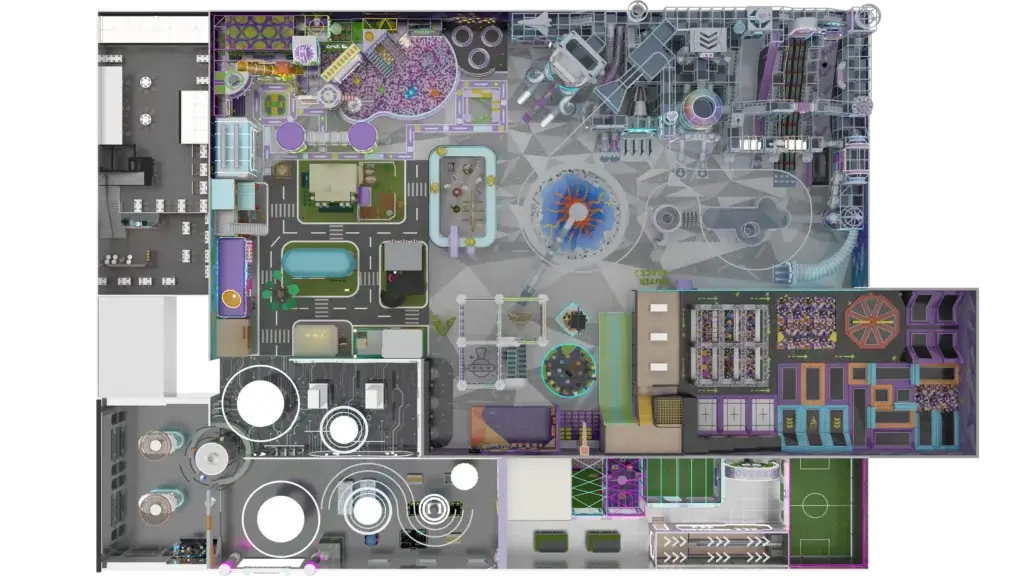
Why 90% of Playground Problems Lie in Layout, Not Equipment
1.1 Industry Background and Market Scale
The global Family Entertainment Center (FEC) and indoor playground market is experiencing substantial growth. According to industry data, the global FEC market is estimated at approximately USD 30 billion in 2025, with a projected compound annual growth rate (CAGR) of 14.7%, expected to reach USD 103.1 billion by 2034. In China alone, the market stood at RMB 39.49 billion (approx. USD 5.4 billion) in 2025. Despite this growth, the majority of indoor playgrounds encounter a performance plateau 18–24 months after opening, characterized by slowing new customer acquisition, declining repeat visitation, and a rise in minor collision incidents.
1.2 The Quantifiable Cost of Suboptimal Layout
Industry practices and research indicate that a suboptimal layout imposes significant performance penalties on indoor playground operations. These impacts can be quantified across three dimensions:
Core Impact Metrics of Inefficient Layout
| Impact Dimension | Quantified Data | Description |
|---|---|---|
| Revenue-per-Square-Meter (sqm) Loss | 20%–40% | Inefficient layout results in low space utilization, leaving certain zones chronically idle. |
| Safety Incident Correlation | Over 70% of minor safety incidents | Directly linked to traffic flow conflicts, including collisions and congestion-induced falls. |
| New Customer Growth | Plateaus after 18–24 months | Spatial appeal decays over time in the absence of a continuous attraction mechanism. |
1.3 Common Cognitive Missteps
Two prevalent but counterproductive responses exist within the industry:
Blind Investment in New Equipment: Adding new equipment may attract short-term attention, but a single large-scale attraction typically costs tens to hundreds of thousands of dollars. Without addressing an underlying layout deficiency, new equipment yields only marginal improvements and substantially extends the return-on-investment timeline.
Over-Reliance on Promotions: Discounts and campaigns can stimulate short-term visitor flow, yet excessive use erodes brand equity, depresses average per-capita spending, and fails to resolve the deteriorating experience and safety risks that stem from layout flaws.
1.4 Core Proposition
The central proposition of this report is that the critical factor impacting an indoor playground’s long-term profitability and safety is the “Layout System Degradation”—the gradual obsolescence of the spatial configuration over time. Spatial layout is not a static, one-time capital investment; it is a dynamic system requiring continuous monitoring, assessment, and iterative optimization.
1.5 Value Statement of This Report
This report delivers a systematic methodology for spatial optimization, enabling operators to enhance safety, improve revenue per square meter, extend dwell time, and activate visitor traffic growth—all without the need for large-scale capital renovation.
Step 1: Spatial "Health Check"—Establishing a Data-Driven Diagnostic System
Scientific spatial optimization begins with precise diagnosis. This chapter presents an upgrade path from intuition-based judgment to data-driven assessment.
The Three-Layer Spatial Diagnostic Model
The diagnostic framework consists of three interconnected dimensions: the Behavior Layer, the Spatial Layer, and the Safety Layer.
The Three-Layer Spatial Diagnostic Model Architecture
| Diagnostic Layer | Core Indicators | Data Collection Methods | Diagnostic Objective |
|---|---|---|---|
| Behavior Layer | Venue heatmaps (high-density zone identification) | Video-based people-counting / Wi-Fi probe analytics | Identify congestion zones and cold zones |
| Behavior Layer | Average Dwell Time | Entry-exit timing / integrated membership system | Evaluate the attractiveness of each zone |
| Behavior Layer | Movement Pattern Tracking | Video tracking / sensor grid grids | Map primary traffic routes and conflict intersections |
| Spatial Layer | Main thoroughfare width | On-site physical measurement | Assess circulation capacity against benchmarks |
| Spatial Layer | Equipment spacing appropriateness | Floor plan analysis | Evaluate space utilization and safety |
| Spatial Layer | Line-of-Sight Coverage Ratio | 3D modeling / on-site observation | Determine parental supervision capability |
| Safety Layer | Incident location distribution | Retrospective analysis of incident reporting system | Pinpoint high-risk zones |
| Safety Layer | High-speed path intersections | Circulation path analysis | Identify collision risk points |
| Safety Layer | Mixed-age activity overlap zones | Age-zone cross-reference analysis | Prevent cross-age conflicts |
Behavior Layer Diagnostic Benchmarks
The Behavior Layer seeks to reveal actual visitor behavioral patterns through quantitative analysis. Key benchmarks are as follows:
Core Judgement Criteria for the Behavior Layer
| Indicator | Healthy Benchmark Range | Warning Signal | Potential Underlying Issue |
|---|---|---|---|
| Single-zone occupant density | ≤0.5–0.8 persons/sqm (peak) | Sustained levels >1.0 persons/sqm | Congestion risk, degraded experience, safety hazard |
| Average Dwell Time | 90–150 minutes (venue-wide) | Below 60 minutes | Insufficient attraction magnetism, experience fatigue |
| Cold Zone Ratio | ≤15% of total operational area | Exceeds 25% | Wasted space, low revenue per sqm |
| High-density zone turnover rate | 30–60 minutes natural rotation | Sustained high density >90 minutes | Lack of natural flow dispersal mechanism |
Note: Benchmarks derived from industry operational practice.
Spatial Layer Diagnostic Benchmarks
The Spatial Layer focuses on two hard metrics: thoroughfare width and line-of-sight coverage.
Key Judgement Criteria for the Spatial Layer
| Judgement Dimension | Recommended Standard | Risk Threshold | Source/Reference |
|---|---|---|---|
| Main thoroughfare width | ≥1.5–2.0 m | <1.2 m indicates congestion risk | Industry design standards |
| Secondary pathway width | ≥1.2 m | <0.9 m impairs circulation efficiency | Industry design standards |
| Parental line-of-sight obstruction ratio | ≤20% | >30% classified as high-risk layout | Safety research & practice |
| Equipment spacing (edge of use zones) | ≥1.8 m | <1.5 m indicates collision risk | ASTM F1487 / EN 1176 |
In design practice, maintaining open sightlines across 80–90% of play areas significantly increases both safety and parental trust, thereby extending dwell time.
Safety Layer Diagnostic Benchmarks
The Safety Layer diagnosis focuses on incident distribution maps and traffic-flow conflict points. Industry data show that over 70% of minor safety incidents are directly linked to circulation conflicts, with intersections consistently representing incident hotspots.
Diagnostic Output
Applying the three-layer model generates a classified diagnostic output, providing clear directives for subsequent optimization:
Diagnostic Output Classification and Corresponding Strategy
| Zone Classification | Identification Criteria | Optimization Direction | Priority |
|---|---|---|---|
| Hot Zone | Sustained high density, long Dwell Time | Diversion design, expand throughput capacity | High |
| Cold Zone | Chronically low utilization, short Dwell Time | Functional reprogramming, introduce high-engagement activities | Medium |
| Risk Zone | High incident frequency, dense traffic-flow intersections | Immediate rectification, physical separation | Highest |
Step 2: Re-establishing Safety Parameters—International Standards and Spatial Logic
Applicable International Safety Standards
The safety design of an indoor playground should align with internationally recognized standard systems. The most influential global standards today include:
Primary International Safety Standards Applicable to Indoor Playgrounds
| Standard System | Area of Application | Latest Edition/Year | Core Content |
|---|---|---|---|
| ASTM F1918 | Soft Contained Play Equipment | 2021 | Safety performance specifications covering users from the 5th percentile 2-year-old to the 95th percentile 12-year-old, aimed at reducing life-threatening and debilitating injuries. |
| ASTM F1487 | Public Playground Equipment | 2025 | Standard safety performance specifications for various types of public playground equipment, including use zones and clearance dimensions. |
| EN 1176 | Fixed Public Playground Equipment and Surfacing | 2024 | General safety requirements and test methods for permanently installed playground equipment for all children. |
| EN 1177 | Impact Attenuating Playground Surfacing | — | Specifies the impact absorption performance requirements for playground surfaces. |
| IAAPA Safety Guides | Ride Operations & Risk Management | — | Provides safety resources, training programs, and industry best practices, covering over 1,400 FEC and LBE businesses globally. |
| EN 71 | Toy Safety (including play-related items) | — | Applicable to play components that can be classified as toys. |
Three Core Safety Optimization Strategies
Physical Age-Group Zoning
Children of different age brackets exhibit profoundly different behavioral patterns, motor skills, and risk awareness. Scientific age zoning is the foundation of safety design.
Age Zone Design Standards
| Age Group | Behavioral Characteristics | Space Type | Recommended Separation Method | Safe Height Reference |
|---|---|---|---|---|
| 0–3 years (Toddlers) | Limited motor skills, requires constant supervision | Low-impact, enclosed space | Padded walls + dedicated entrance | <1.0 m |
| 4–6 years (Preschool) | High exploratory behavior, larger motor movements | Exploratory interactive space | Shoe locker areas / half-height soft barrier | 1.0–2.0 m |
| 7–12 years (School-age) | High-intensity physical activity, competitive play | High-energy activity space | Complete physical separation | 2.0–3.0 m |
Note: Adapted from industry design practice.
In practice, operators should employ padded walls, shoe-storage benches, and resting islands as hard separation tools, avoiding cross-traffic between age groups. Each age zone should also feature its own dedicated entrance and supervisory area.
Line-of-Sight Transparency Design
Safety is not merely physical but also psychological for parents. Research indicates that when a parent’s line of sight is obstructed by more than 30%, the layout constitutes a high-risk design that will degrade satisfaction and repeat visitation. Optimization methods include:
Minimizing solid barriers; employing transparent materials (mesh netting, acrylic panels) in place of opaque walls.
Positioning parent seating in central or elevated vantage points, maintaining a supervision distance of 1.8–4.0 m.
Ensuring a parent can visually locate their child within 3 seconds.
Traffic Flow and Egress Systems
Scientific circulation design is fundamental to safe operations. Key principles for pathway planning include:
Eliminating Dead Ends: All paths should form loop circuits, ensuring continuous visitor flow rather than forced backtracking.
Unobstructed Main Arteries: Maintain main thoroughfare width at 1.5–2.0 m or greater to support smooth bidirectional flow.
Separating Fast/Slow Traffic: Spatially segregate running-active zones from strolling and F&B relaxation areas.
Clear Emergency Egress Signage: Ensure visitors can evacuate quickly and orderly in an emergency.
Fall Zone Configuration
Configuring the fall zone is one of the core differences between professional design and generic layout. Every piece of equipment with an elevated platform must have a compliant safety buffer space.
Fall Zone Configuration Reference
| Equipment Fall Height | Minimum Safety Radius | Surfacing Requirement | Standard Basis |
|---|---|---|---|
| ≤0.6 m | ≥1.5 m | Standard cushioned matting | ASTM F1487 / EN 1176 |
| 0.6–1.5 m | ≥1.8 m | Impact-attenuating surfacing (CFH compliant) | ASTM F1292 / EN 1177 |
| 1.5–3.0 m | ≥2.5 m (+0.5 m for every additional 1 m height) | High-impact attenuating surfacing | ASTM F1292 Class II or above |
Note: The greater the fall height, the larger the safety radius required, along with increased impact attenuation performance for the surfacing.
Material Safety
Material safety is an indispensable foundational layer of the spatial safety system.
Play Equipment Material Safety Standards
| Standard Category | Standard Number | Test Content | Applicable Scenario |
|---|---|---|---|
| Fire Rating | IBC / National Building Codes | B1 or higher flame-retardant performance | All soft-play materials and fabrics |
| Environmental (EU) | EN 71 | Heavy metals, phthalates, formaldehyde, etc. | Accessible materials |
| Environmental (USA) | ASTM F963 | Heavy metals, mechanical/physical properties, flammability | Toys and play components |
| China National Standard | GB 6675 | Toy and children’s product safety | Projects within China |
| Abrasion Resistance | Industry Test Methods | Martindale abrasion test | High-frequency contact surfaces |
| Antibacterial Properties | ISO 22196 / JIS Z 2801 | Antibacterial rate ≥99% | All touch surfaces |
Note: Synthesized from industry standard practices.
Step 3: Embedding Growth Engines for Traffic and Revenue
Safety is the baseline; however, a superior spatial layout must also be engineered to drive revenue generation. This chapter elevates the perspective from “spatial design” to “revenue design,” introducing the Three-Zone Revenue Model.
The Three-Zone Revenue Model
Revenue Zone Model
| Zone Type | Functional Role | Typical Attractions | Core KPI | Suggested Space Allocation |
|---|---|---|---|---|
| Attraction Zone | Drive first-time visitation | Large slides, climbing towers, trampolines | New customer acquisition, social media exposure | 30%–40% |
| Dwell Zone | Maximize length of stay | Sandpits, interactive projections, role-play | Average Dwell Time, guest satisfaction score | 35%–45% |
| Monetization Zone | Increase per-capita spend and profit | Party rooms, F&B areas, retail | Secondary spend ratio, average ticket value | 20%–25% |
Industry cases demonstrate that a well-reasoned revenue-zone layout effectively increases per-capita spending and profit margins. The proportion of secondary revenue can reach 72% at benchmark locations, primarily from retail and F&B, where IP-derivative sales can achieve five times the turnover of a standard store. Research data shows that indoor playgrounds with clearly defined zones and open sightlines can extend children’s stay time by 25% and increase repeat visitation by 20%.
Cold Zone Transformation Strategy
A “Cold Zone” refers to a persistently underutilized area. Transformation should be triggered when cold-zone area exceeds 25% of total operational space, or a zone’s Dwell Time is consistently below 50% of the venue average.
Strategy recommendations:
Assess Existing Equipment Efficiency: Conduct a data-driven evaluation (revenue contribution per square meter). Prioritize the replacement of equipment performing below 70% of target.
Introduce High-Engagement, Small-Footprint Activities: Interactive projection games (~10–15 sqm/unit), DIY crafting corners, role-play village concepts.
Modular Spatial Reconfiguration: Replace fixed installations with movable modular facilities to preserve future spatial flexibility.
In practice, reducing the cold-zone footprint to below 15% can yield a per-square-meter revenue uplift of 30%–80%.
Secondary Spend Path Design
The core principle of secondary spend path design is to enable transactions to occur “naturally along the journey,” not through force.
Secondary Spend Path Optimization Tactics
| Pathway Node | Optimization Tactic | Expected Effect |
|---|---|---|
| Entrance/Exit | Route past the retail area | Maximizes exposure, stimulates departure purchase |
| Core Circulation | Flow through the F&B zone | Increases food & beverage touchpoints |
| Photo/Instagram Spots | Adjacent to paid attraction entrances | Leverages social sharing desire to prompt purchase |
| Seating/Rest Areas | Proximate to vending or a coffee nook | Capitalizes on dwell moments for impulse buying |
| Redemption Counter | At a high-flow circulation intersection | Maximizes game-play revenue exposure |
Case studies show that relocating redemption counters to a prominent spot near the party booking desk can generate a 22% year-over-year increase in redemption game revenue.
Upgrading the Parent Comfort Zone
In the parent-child consumption scenario, children determine “whether to come,” but parents determine “how many times they return.” The parent comfort zone is the core driver of repeat visitation.
Parent Comfort Zone Design Standards
| Design Element | Standard Recommendation | Design Rationale |
|---|---|---|
| Viewing Position | Central or elevated, supervision distance of 1.8–4.0 m | Supervisory safety + psychological comfort |
| Seating Comfort | Soft seating with backrests and armrests | Extends effective on-site stay time |
| Amenities | Power outlets (min. 1 USB port per seat), free Wi-Fi, small tabletop | Enables light work/leisure |
| Service Area per Seat | 2.0–2.5 sqm per person (including walkways) | Spatial comfort assurance |
Note: Adapted from industry design benchmarks.
Step 4: On-the-Ground Execution—A Low-Cost, High-ROI Implementation Pathway
Phased Construction Strategy
To minimize operational disruption, layout optimization should follow a phased implementation schedule:
Phased Construction Plan
| Phase | Time Window | Scope of Work | Operational Impact |
|---|---|---|---|
| 1 | Daytime operations (Mon–Thu off-peak) | Non-core area renovation, cold-zone reconfiguration | Partial, temporary zone closures |
| 2 | Overnight (after hours) | Main thoroughfare modifications, floor surfacing replacement | No direct impact |
| 3 | Rolling zone upgrades | Large-equipment adjustments, zone partitioning | Sequential, zone-by-zone rotation closures |
Modular Upgrade Philosophy
The ability to achieve high impact at low cost hinges on modular thinking:
Retain primary structures (steel framework, load-bearing elements) and replace only soft padding and finishes—this can save 40%–60% of renovation costs.
Optimize entrances/exits and circulation: Adjusting pathway direction and partition positions alone can create substantial improvements in pedestrian flow.
Adopt reconfigurable, modular play components to ensure ongoing flexibility for adjustments informed by operational data.
Return on Investment Analysis
A well-executed layout optimization project consistently delivers compelling returns.
Typical ROI Data for Layout Optimization Projects
| KPI | Expected Improvement Range | Context |
|---|---|---|
| Visitor Traffic Increase | +15% to 30% | Driven primarily by attraction zone optimization and cold-zone activation |
| Dwell Time Increase | +20% to 40% | Driven by dwell zone optimization and parent comfort upgrades |
| Per-Capita Spending Increase | +10% to 25% | Driven by secondary-spend path design and monetization zone layout |
| Safety Incident Rate Reduction | -30% or better | Driven by circulation optimization and physical age-group zoning |
| Investment Payback Period | 3–9 months | Based on combined revenue uplift versus renovation cost |
Industry practice shows that re-planning existing space – rather than expanding – can simultaneously yield capacity gains, operational efficiency, and multi-age-group coverage. In a shopping-center setting, a compact 800–2,000 sqm FEC can achieve payback within 2–14 months. In cases of robust layout optimization, average guest spend can grow by 27% within 6 months of adjustment, and the payback period can shorten from 24 months to 18 months.
Case Study and Performance Comparison
Illustrative Case: Layout Optimization of a 3,000 Sqm Family Entertainment Center
Before-and-After Comparison
| Dimension | Before Optimization | After Optimization | Magnitude of Change |
|---|---|---|---|
| Circulation State | Main walkway only 1.0 m, frequent bottleneck congestion | Main walkway widened to 1.8 m+, loop circuits implemented | Throughput efficiency dramatically improved |
| Cold Zone Ratio | ~32% of operational area chronically idle | Reduced to 12%, all converted to active zones | Cold-zone area reduced by ~60% |
| Safety Incidents | Average 3–5 minor collisions per month | Reduced to under 1 per month | Incident rate reduced by >70% |
| Visitor Distribution | Front area chronically overcrowded, rear area empty | Balanced distribution of visitors venue-wide | Space utilization rate significantly up |
| Average Dwell Time | ~85 minutes | ~110 minutes | Extended by ~29% |
| Secondary Spend Ratio | ~28% | ~42% | Increased by 14 percentage points |
| Parent Satisfaction Score | 3.2 / 5.0 | 4.4 / 5.0 | Substantial improvement |
Note: Case data synthesized from industry practice composites.
Key Transformation Interventions
The transformation in this composite case centered on:
Reconfiguring the central arcade and redemption area to create an open, high-visibility core with carefully designed pathways, yielding an 18% increase in high-margin zone dwell time within the first quarter.
Establishing a physical age-zoning system with transparent partitions instead of solid walls to dramatically improve the parental line-of-sight ratio.
Rebuilding the secondary spend path by moving the redemption counter from a corner to a main corridor intersection and introducing additional in-line vending nodes.
Upgrading the parent seating zone, adding power-enabled, comfort seating positioned at a central, elevated vantage point.
Conclusion: Layout Is the Most Underestimated Profitability Tool
This report has set forth a comprehensive methodology for indoor playground layout optimization—starting with the establishment of a data-driven diagnostic system, proceeding through a safety upgrade guided by international standards, and culminating with the integration of revenue-growth engines and a phased implementation plan.
The value of a well-designed spatial layout far surpasses the sum of its functions:
It is an “Invisible Safety System“ — reducing accident risk at the source through scientific zoning, line-of-sight transparency, and traffic-flow separation, rather than relying on after-the-fact management.
It is an “Automated Guest Flow Guidance Tool“ — through rational revenue zoning and secondary-spend path design, the natural flow of visitors inherently serves revenue growth.
It is, fundamentally, a “Continuously Revenue-Generating Spatial Asset“ — a scientifically optimized layout yields compounding returns across its entire operating lifecycle.
In an increasingly competitive landscape, layout optimization provides indoor playground operators with a low-cost, high-return, sustainable upgrade pathway. It requires neither massive capital injections nor aggressive market tactics, but rather the fine-grained operational eye to unlock the overlooked potential embedded in the existing physical asset.
Spatial layout is the core competitive advantage that every indoor playground should evaluate first and optimize continuously.